IND W vs JPN W – Cricket Highlights | Asian Games 2026
Match Summary
| Match Detail | Information |
|---|---|
| Match/Tournament Name | Asian Games Women’s Cricket Competition 2026 – 4th Quarter-Final |
| Teams | India Women vs Japan Women |
| Date & Venue | September 18, 2026 – Korogi Sports Park, Nisshin, Japan |
| Format | Women’s T20 International |
| India Captain | Harmanpreet Kaur |
| Japan Captain | Mai Yanagida |
| India Head Coach | Amol Muzumdar |
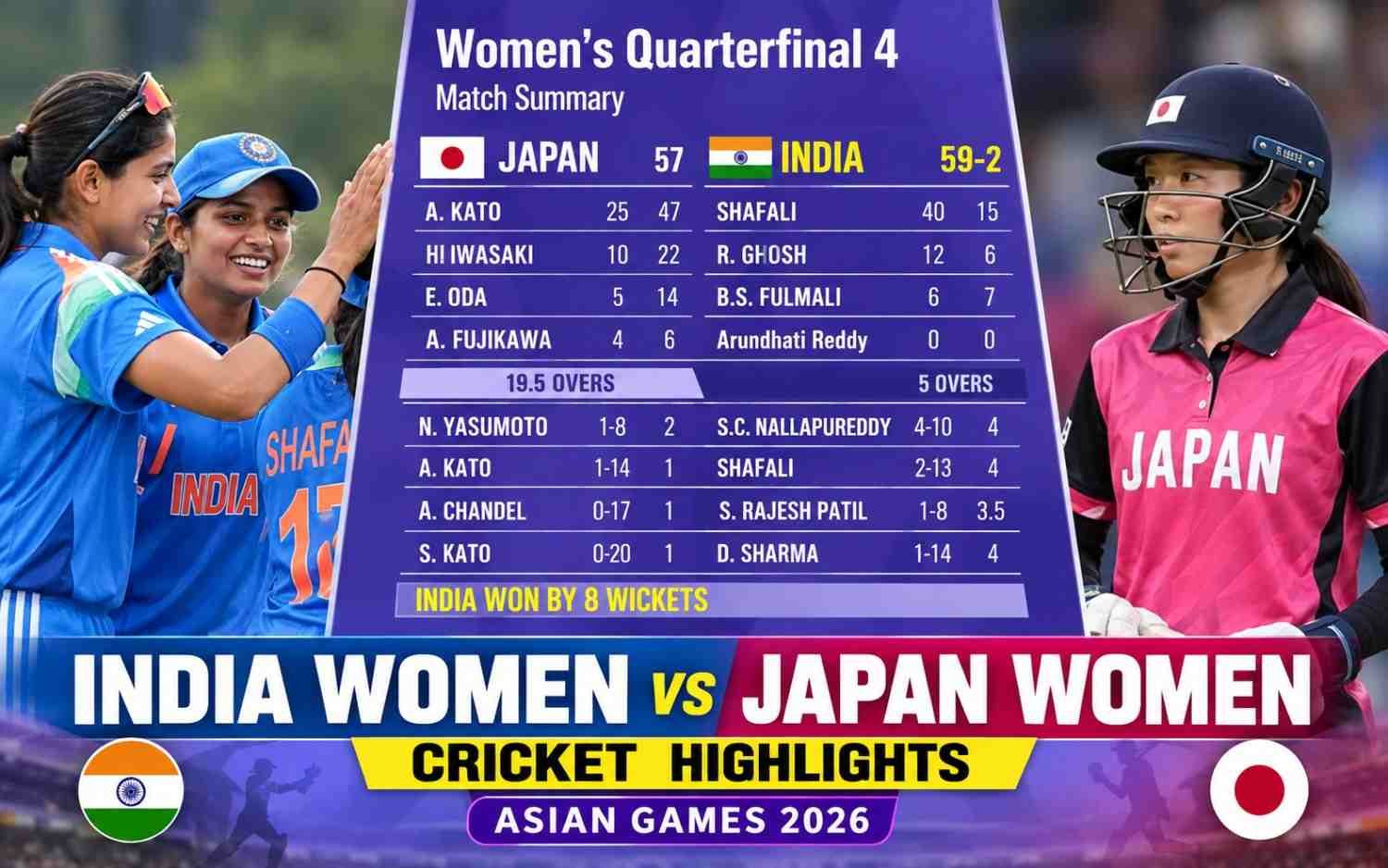
| Japan Innings | 57 all out in 19.5 overs |
| India Innings | 59/2 in 5 overs |
| Result | India Women won by 8 wickets |
| Player of the Match | Shree Charani |
| Top India Batter | Shafali Verma – 40* off 15 balls |
| Top Japan Batter | Ayaka Kato-Stafford – 25 runs |
| Best Bowler | Shree Charani – 4/10 in 4 overs |
| Semi-Final | India Women vs Bangladesh Women |
India Women began their Asian Games 2026 women’s cricket campaign with a commanding eight-wicket victory over hosts Japan Women at Korogi Sports Park in Nisshin. After winning the toss, Harmanpreet Kaur’s India elected to bowl and produced an outstanding bowling performance, restricting Japan to only 57 runs in 19.5 overs. India then needed just five overs to reach 59/2 and secure their place in the semi-finals.
IND W vs JPN W – Cricket Highlights | Asian Games 2026
Match Overview & Key Highlights
The IND W vs JPN W Asian Games 2026 quarter-final represented a significant occasion for both teams. India entered the competition as the defending women’s cricket champions, while Japan were playing on home soil and received a direct route into the quarter-final stage.
India’s combination of international experience and recent form made them a formidable opponent. The team had also arrived in Japan shortly after winning the Women’s Asia Cup 2026, giving players such as Shafali Verma, Smriti Mandhana, Harmanpreet Kaur, Deepti Sharma and Shree Charani considerable momentum. India were coached by Amol Muzumdar, while Japan were led by Mai Yanagida.
The match quickly developed into a one-sided contest after India chose to bowl. Japan’s opening pair survived the initial powerplay, but India’s spin attack gradually tightened the pressure. Shree Charani emerged as the standout bowler, claiming four wickets for only 10 runs.
Japan could manage just 57 all out, with Ayaka Kato-Stafford’s 25 being their highest score. India then produced an explosive response. Although Japan picked up two early wickets, Shafali Verma’s unbeaten 40 from 15 deliveries ensured there was no late drama. India completed the chase in only five overs, winning with 90 balls remaining.
First Innings Analysis: India Spin Attack Destroys Japan’s Batting
Japan began their innings carefully and managed to reach the end of the powerplay without losing a wicket. Ayaka Kato-Stafford and Haruna Iwasaki initially resisted India’s attack, with Japan moving to 23/0 during the opening six overs.
India’s strategy then shifted toward sustained spin pressure. Shree Charani, Deepti Sharma and Shafali Verma played central roles as the Indian attack repeatedly challenged Japan’s batters.
Charani’s spell became the defining feature of the innings. The left-arm spinner produced outstanding control and variation, finishing with 4 wickets for 10 runs from four overs. She also bowled two maiden overs, making her spell even more influential.
Charani’s breakthrough of Mai Yanagida was especially important. She then struck again in quick succession, creating a collapse that prevented Japan from building a competitive total. Her four-wicket haul was reported as the best bowling performance by an Indian in Asian Games history.
Japan’s batting became increasingly difficult as wickets fell. Haruna Iwasaki and Ayaka Kato-Stafford were among the few players able to spend meaningful time at the crease. Kato-Stafford eventually finished with 25, while Iwasaki contributed 10. Other Japanese batters struggled to convert starts into partnerships.
Shafali Verma also contributed with the ball, taking 2/13 from four overs. Deepti Sharma and Shreyanka Patil added wickets as India’s spin-heavy attack kept Japan under constant pressure.
Japan were eventually bowled out for 57 in 19.5 overs, leaving India a target of only 58.
Turning Point & Crucial Performances
The biggest turning point arrived when Shree Charani removed two Japanese batters in two deliveries during the seventh over. That double strike transformed a relatively cautious start into a collapse.
Japan had successfully navigated the first six overs without losing a wicket, but the introduction and sustained use of India’s spin attack changed the tempo. Charani’s ability to extract turn while maintaining a tight line made it difficult for Japan’s middle order to score freely.
Her final figures of 4/10 from four overs were exceptional in both economy and wicket-taking impact. Charani’s performance was particularly notable because she had also produced a four-wicket haul in the Women’s Asia Cup final against Sri Lanka shortly before the Asian Games. She therefore arrived in this quarter-final with strong recent momentum.
Another notable achievement came from Deepti Sharma, who became the first Indian to take a wicket in two editions of the Asian Games. That added historical significance to India’s bowling performance.
Japan’s Ayaka Kato-Stafford was their most productive batter. Her 25 runs represented a significant portion of Japan’s final total, but the lack of substantial partnerships meant that India could keep attacking rather than shifting into defensive bowling.
India’s chase then produced another dramatic individual performance.
Shafali Verma walked into the chase with India requiring only 58 runs, but Japan briefly created an opening by dismissing G Kamalini and Bharti Fulmali. Kamalini was dismissed for a duck, while Fulmali made six from seven deliveries.
That brought Richa Ghosh together with Shafali, and the pair immediately accelerated the chase.
Shafali finished unbeaten on 40 from just 15 balls, striking at 266.67. Her innings contained six fours and two sixes, turning what could have been a routine chase into a spectacular batting display.
Richa Ghosh provided excellent support with 12 not out from six balls, including two boundaries. The pair took India from a potentially cautious position to victory in only five overs.
The final blow came from Shafali herself, who launched a six to complete the chase. India reached 59/2 in exactly five overs, finishing the contest with an enormous 90 deliveries still unused.
Second Innings & Tactical Breakdown
India’s chase demonstrated the value of aggressive intent even when the target was extremely small.
The required run rate was only 5.80 per over, but India scored at 11.80 runs per over, completing the chase twice as quickly as required.
Japan did manage two early breakthroughs. Nonoha Yasumoto dismissed G Kamalini, while Ayaka Kato-Stafford removed Bharti Fulmali. Those wickets gave Japan a brief opportunity to create pressure.
However, the bowling lacked the consistency needed to defend such a tiny total. Ahilya Chandel conceded 17 runs from her over, while Shimako Kato went for 20 runs in her only over. Shafali capitalized on anything loose, repeatedly finding gaps and clearing the boundary.
Shafali’s ability to score rapidly eliminated any possibility of a Japanese comeback. Her combination with Richa Ghosh meant India did not need contributions from the experienced Smriti Mandhana, Harmanpreet Kaur or Deepti Sharma, all of whom remained unused with the bat.
From India’s perspective, the chase was efficient, aggressive and strategically uncomplicated: finish the match quickly and conserve resources for the semi-final.
Key Statistics & Milestone Records
- Japan Women: 57 all out in 19.5 overs.
- India Women: 59/2 in 5 overs.
- Result: India won by 8 wickets.
- Balls remaining: 90.
- Shree Charani: 4/10 in four overs.
- Shafali Verma: 40* off 15 balls.
- Shafali’s strike rate: 266.67.
- Shafali’s boundaries: Six fours and two sixes.
- Shafali’s bowling: 2/13 from four overs.
- Richa Ghosh: 12* off six balls.
- Japan’s highest scorer: Ayaka Kato-Stafford, 25.
- Haruna Iwasaki: 10 runs.
- Shree Charani’s four wickets: Included a crucial double strike in the seventh over.
- India’s chase: Completed in only five overs.
- India’s powerplay score: 59/2.
- Tournament stage: Quarter-final.
- Next opponent: Bangladesh Women in the semi-final.
The victory also set a notable Indian T20I record in terms of balls remaining. India completed the chase with 90 balls to spare, surpassing their previous women’s T20I record of 84 balls remaining against Thailand in 2022.
Post-Match Impact & What’s Next
The victory sends India Women into the semi-finals of the Asian Games 2026 women’s cricket competition, where they will face Bangladesh Women. The other semi-final features Sri Lanka Women against Pakistan Women. Both semi-finals are scheduled for September 20 at Korogi Sports Park.
For India, the quarter-final delivered contributions from both established stars and emerging performers. Shree Charani’s 4/10 destroyed Japan’s batting structure, while Shafali Verma’s 40 from 15 balls* ensured an emphatic finish.
The defending champions have therefore opened their Asian Games title defence in decisive fashion, combining disciplined spin bowling with explosive top-order batting. Japan, meanwhile, can take significance from hosting and competing in a major Asian Games women’s cricket fixture, while India’s attention now turns toward the semi-final challenge against Bangladesh.
Correct the match summary wordingRemove repeated match details