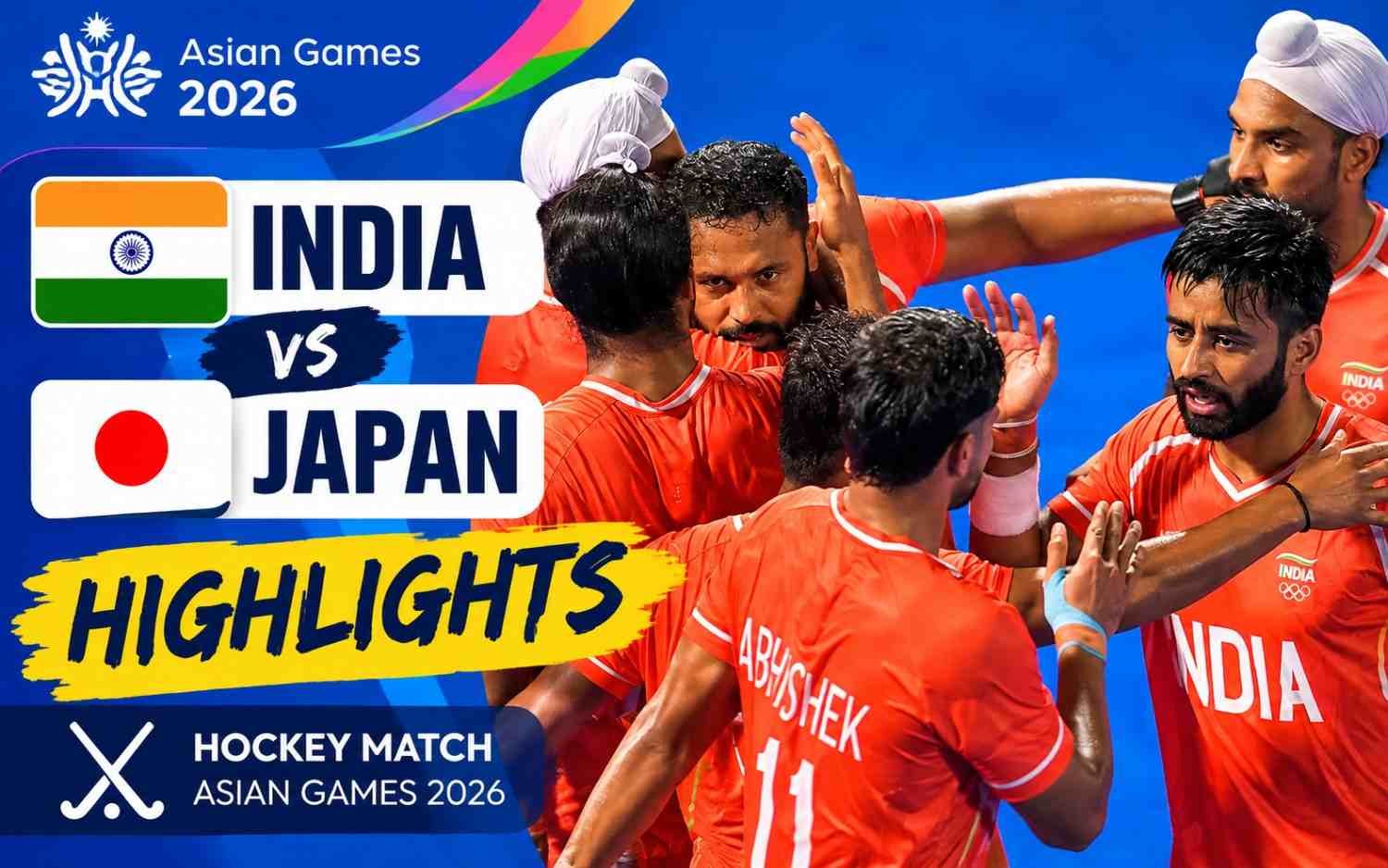
Highlights – IND vs JPN Hockey Match | Asian Games 2026
Match Summary
| Match Attribute | Details |
| Tournament Name | Asian Games 2026 (Men’s Hockey – Pool A Group Stage) |
| Teams Involved | India Men’s Hockey Team vs Japan Men’s Hockey Team |
| Date & Venue | September 26, 2026 | Oi Hockey Stadium, Tokyo, Japan |
| Key Performers | Harmanpreet Singh (1 Goal, Defensive Anchor), Abhishek (1 Goal), Suraj Karkera (Goalkeeper – Clean Sheet), Sanjay (Goal-line clearance on 100th Cap) |
| Final Result / Score | India 2 – 0 Japan |
Highlights – IND vs JPN Hockey Match | Asian Games 2026
Match Overview & Key Highlights
In what was billed as the defining fixture of Pool A at the Asian Games 2026, the Indian Men’s Hockey Team delivered a masterclass in tactical discipline and clinical execution to overcome a resilient Japanese side 2-0. Both teams entered this pivotal clash with flawless records, having won all three of their opening league encounters. With the top spot in Pool A and an assured passage to the semi-finals on the line, the stakes could not have been higher at the Oi Hockey Stadium.
The rematch carried immense historical weight, reviving memories of the 2022 Hangzhou Asian Games where India bested Japan 4-2 in the group phase before dominating them 5-1 in the gold medal match. Led onto the pitch by skipper Harmanpreet Singh, the Indian contingent faced a formidable Japanese lineup captained by their indefatigable talisman, Raiki Fujima. The atmosphere was electrifying, marked by a pre-match milestone as Indian defender Sanjay celebrated his 100th international cap.
From the opening whistle, the battle in the midfield was intense. India’s central engine room—comprising Hardik Singh, Vivek Sagar Prasad, Manpreet Singh, and Rajinder Singh—faced off against Japan’s technically precise setup. While Japan displayed exceptional structure and relentless pressing, India showed superior composure in critical moments, capitalizing on key opportunities while maintaining a resolute defense to secure a well-deserved victory and top position in Pool A.
First Half Analysis
The opening quarter unfolded as a high-tempo tactical chess match, with both sides testing each other’s defensive structure. India registered the first major offensive foray when Manpreet Singh controlled a long scoop pass inside the attacking circle, earning India’s first penalty corner after the ball struck a Japanese defender’s foot. Japan’s defense, recognized alongside India’s as one of the most formidable penalty corner defensive setups in Asian hockey, stood firm. Raiki Fujima rushed down the drag-flick effort, sparking a lightning-fast counter-attack that forced Indian custodian Suraj Karkera into an early reactive save.
Japan continued to press forward, finding pocket spaces in the central midfield. Their persistent circle entries paid dividends when they won a penalty corner midway through the opening phase. Captain Raiki Fujima stepped up to executive the drag-flick, but India’s defensive wall deflected the threat comfortably.
As the second quarter commenced, India shifted gear into a higher offensive rhythm. Harmanpreet Singh demonstrated his world-class passing range by launching a monstrous aerial ball deep into the Japanese circle. Forward Abhishek brought down the pass and uncorked a scorching reverse tomahawk that narrowly zipped over the crossbar, putting Japanese goalkeeper Takashi Yoshikawa on high alert.
The deadlock was broken shortly after through a flash of brilliance from Abhishek. Gathering the ball deep inside the striking circle surrounded by three Japanese defenders, Abhishek eschewed the traditional back-lift hit, opting instead for a lightning-fast push shot. The sudden release caught the Japanese defense off guard, slinging past Yoshikawa into the back of the net to give India a 1-0 lead.
Japan responded with urgency before the halftime hooter, winning back-to-back penalty corners. However, India’s first runner, Amit Rohitas, sprinted out courageously to block the direct attempts, preserving India’s slender single-goal cushion going into the long break.
Turning Point & Crucial Performances
The pivotal moment that fundamentally altered the trajectory of the match occurred in the third quarter. Japan had begun asserting immense pressure, creating a sequence of goal-scoring opportunities. During a chaotic Japanese penalty corner, Shota Yamada fired a low drag-flick past the keeper, only for Indian milestone-man Sanjay to execute a miraculous goal-line save on his 100th international appearance, keeping the ball out with his stick on the baseline.
Moments later, Japan threatened again through open play as a deflected strike rattled off the upright frame of Suraj Karkera’s goal. Having weathered Japan’s fiercest attacking storm, India immediately launched a counter-offensive.
The decisive tactical turn came when Mandeep Singh drew a deliberate foul from Japanese defender Shota Yamada inside the circle, winning India a crucial penalty corner. With Yamada arriving late on the rush, Indian skipper Harmanpreet Singh was granted vital extra time to calibrate his strike.
Harmanpreet unleashed a trademark, high-velocity drag-flick low to Takashi Yoshikawa’s right stick side. The sheer power and precision of the shot proved unstoppable, slamming into the net to make it 2-0 for India.
Key Player Highlights
- Harmanpreet Singh: Led from the front with immaculate defensive positioning, pinpoint long-range aerial distribution, and the match-clinching drag-flick goal.
- Abhishek: Showed elite goal-scoring instincts with his sudden-release push shot for the opening goal, remaining a constant menace for the Japanese defense.
- Sanjay: Celebrated his 100th cap with a heroic performance, highlighted by a match-saving goal-line clearance during Japan’s peak pressure period.
- Suraj Karkera: Stood tall between the goalposts, making key saves in crucial moments to ensure India kept a clean sheet.
- Raiki Fujima & Shota Yamada: Primary catalysts for Japan, driving their transition play and penalty corner routines throughout the match.
Second Half & Tactical Breakdown
Entering the final quarter with a 2-0 deficit, Japan adopted an aggressive, high-pressing tactical formation, pushing extra numbers into the attacking third. They frequently varied their attack, utilizing long aerial passes from the left flank to quickly switch play to the right wing, seeking to exploit dynamic overloads.
India’s head coach and tactical team responded by setting up a disciplined, mid-block defensive structure. The defensive backline—anchored by Harmanpreet Singh, Jarmanpreet Singh, Amit Rohitas, and Jugraj Singh—maintained strict zonal coverage, effectively funneling Japan’s attacks into low-risk perimeter areas. When Japan did manage to penetrate the circle, Suraj Karkera’s composure in goal eliminated secondary chances.
Offensively, India relied on quick counter-attacks to exploit the spaces left behind by Japan’s advanced lines. Rajkumar Pal nearly extended the lead when his tight-angle reverse sweep thudded against the outer side-netting. Shortly after, a swift passing combination between Mandeep Singh and Dilpreet Singh split the Japanese defense, though Dilpreet’s square pass narrowly missed Mandeep’s outstretched stick at the far post.
In the closing minutes, Japan earned one final penalty corner following a high stick infraction. However, a miscommunication on the insertion trap allowed India’s defensive unit to clear the threat cleanly, running down the clock to seal a comprehensive 2-0 victory.
Key Statistics & Milestone Records
- Match Result: India 2 – 0 Japan
- Goal Scorers:
- India: Abhishek (Field Goal – 2nd Quarter), Harmanpreet Singh (Penalty Corner – 3rd Quarter)
- Japan: None
- Penalty Corner Conversion Rate:
- India: 1 / 4 (25%)
- Japan: 0 / 5 (0%)
- Milestone Record: Indian defender Sanjay officially completed 100 International Caps for the Indian Men’s Senior Hockey Team during this match, contributing a match-defining goal-line clearance.
- Defensive Record: India recorded their first clean sheet against a top-tier Asian opponent in the 2026 tournament, having conceded goals in their previous group encounters.
- Head-to-Head Streak: India extended their unbeaten streak against Japan at the Asian Games to 4 consecutive matches (spanning the 2018, 2022, and 2026 editions).
Post-Match Impact & What’s Next
This victory secures India the top spot in Pool A of the Asian Games 2026 hockey tournament with an unblemished record of four wins from four matches. By finishing as group leaders, India avoid the top seed from Pool B in the cross-over semi-final matchups, setting up a favorable semi-final clash as they pursue the gold medal and direct qualification for international showpiece events.
For Japan, despite the defeat, their disciplined performance against the highest-ranked team in the continent demonstrates their growth under head coach instructions. Finishing second in Pool A, Japan also advance to the semi-final stage, where they will face the top-ranked team from Pool B.
India’s clinical performance—combining sharp offensive execution with a resilient defensive display—reaffirms their status as the team to beat at the 2026 Asian Games. As the tournament enters its knockout phase, Harmanpreet Singh’s side looks primed and confident to defend their continental crown.