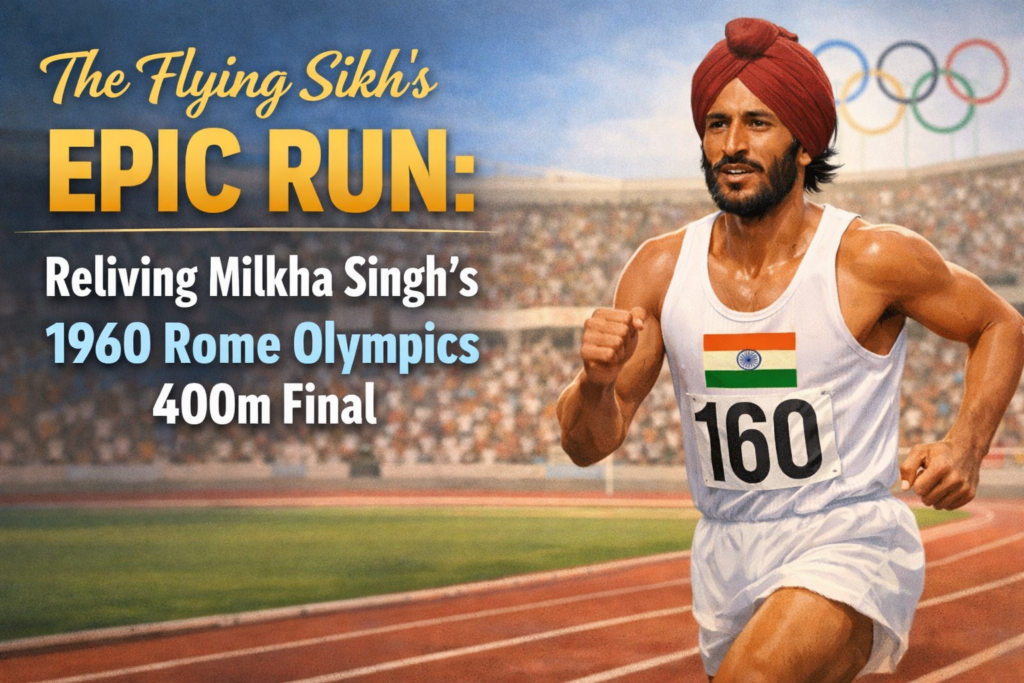
In the annals of Olympic history, few races capture the essence of triumph and heartbreak quite like the men’s 400m final at the 1960 Rome Olympics. This iconic event, immortalized in archival footage from WildFilmsIndia’s YouTube video, showcases India’s legendary sprinter Milkha Singh—affectionately known as the “Flying Sikh”—competing against the world’s elite. The video, titled “Flying Sikh Milkha at Historic 1960 Olympics: 400m with Otis Davis, Carl Kaufmann and Milkha Singh,” transports viewers back to a moment where records were shattered, and a medal slipped away by the slimmest of margins.
Who Was Milkha Singh?
Born in 1929 in what is now Pakistan, Milkha Singh rose from humble beginnings to become one of India’s greatest athletes. Orphaned during the Partition of India in 1947, he joined the Indian Army, where his running talent was discovered. By the late 1950s, Milkha had already claimed gold medals in the 200m and 400m at the 1958 Asian Games, establishing himself as a dominant force in Asia. His nickname, “The Flying Sikh,” reflected his Sikh heritage and his blistering speed on the track. Heading into the 1960 Olympics, Milkha was India’s hope for a breakthrough in athletics, a sport where the nation had yet to make a significant mark on the global stage.
The Stage: Rome 1960 Olympics
The XVII Olympiad in Rome was a spectacle of athletic prowess, drawing competitors from 83 nations. The men’s 400m event was particularly stacked, featuring athletes who had already pushed the boundaries of human speed. In the semifinals, multiple runners matched or bettered the existing Olympic record of 45.9 seconds, setting the stage for a historic final. Milkha Singh qualified comfortably, clocking 45.8 seconds in his semifinal—tying the old record and fueling expectations back home.
The final lineup included:
- Otis Davis (USA), a rising star from the University of Oregon.
- Carl Kaufmann (West Germany), a European champion.
- Malcolm Spence (South Africa), known for his endurance.
- Milkha Singh (India), the Asian sensation.
- Manfred Kinder (West Germany).
- Earl Young (USA).
As the video footage reveals, the athletes burst from the blocks “off like bullets,” with the crowd’s roar echoing through the Stadio Olimpico.
The Race: A Heart-Pounding Battle
The gun fired, and the six finalists exploded into action. Milkha Singh, wearing India’s colors, took an early lead, showcasing the form that had made him a continental king. As the race unfolded, the competition intensified. Otis Davis and Carl Kaufmann surged ahead, battling neck-and-neck in a duel that would redefine the event’s world record.
In the final stretch, Milkha glanced back—a momentary lapse in focus that proved costly. This hesitation allowed Spence to edge past him. The finish was so close that it required a photo finish to determine the medalists. The video captures this tension: the strained faces, the pounding feet, and the dramatic lean at the line, accompanied by applause and music that heighten the drama.
Final Results
| Position | Athlete | Country | Time | Notes |
|---|---|---|---|---|
| 1st | Otis Davis | USA | 44.9 s | World Record |
| 2nd | Carl Kaufmann | West Germany | 44.9 s | |
| 3rd | Malcolm Spence | South Africa | 45.5 s | |
| 4th | Milkha Singh | India | 45.6 s | National Record (lasted 44 years) |
| 5th | Manfred Kinder | West Germany | 45.9 s | |
| 6th | Earl Young | USA | 45.9 s |
Milkha’s time of 45.6 seconds not only set a new Indian national record but held firm until 2004. He missed the bronze by just 0.1 seconds—a razor-thin margin that has become legendary in Indian sports lore.
The Aftermath and Legacy
Though Milkha finished fourth, his performance inspired a nation. He later reflected on the race as a turning point, motivating him to greater heights, including another Asian Games gold in 1962. The “Flying Sikh” went on to receive the Padma Shri, India’s fourth-highest civilian award, and his story was immortalized in the 2013 Bollywood film Bhaag Milkha Bhaag.
Even today, Milkha’s run symbolizes resilience and the pursuit of excellence. As one YouTube commenter noted, “This is the race that changed Milkha Singh’s life and he was much more motivated after running with those big names.” His legacy endures, reminding athletes worldwide that sometimes, the greatest victories come from the narrowest defeats.