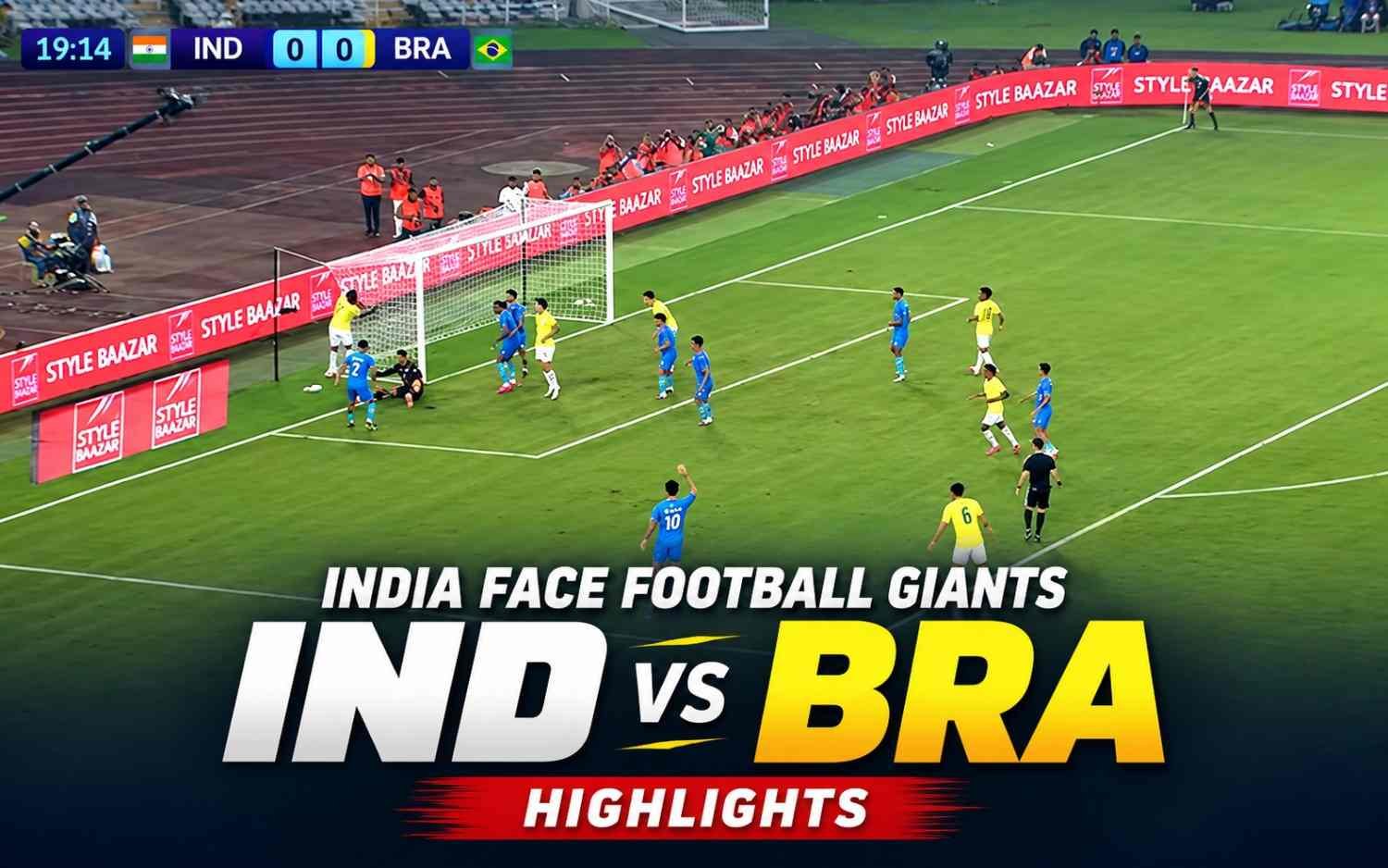
India Face Football Giants | IND vs BRA Highlights
Match Summary
| Match/Event | Details |
|---|---|
| Match | India vs Brazil – International Friendly |
| Teams | India vs Brazil |
| Date & Venue | October 3, 2026 – Vivekananda Yuba Bharati Krirangan (Salt Lake Stadium), Kolkata |
| India Head Coach | Khalid Jamil |
| Brazil Head Coach | Carlo Ancelotti |
| India Captain | Gurpreet Singh Sandhu |
| Brazil Captain | Marquinhos |
| Key Performers | Estêvão, Pedro, Samuel Lino |
| Final Result | India 0-4 Brazil |
| Goals | Estêvão 28′, Pedro 42′, Samuel Lino 58′, 90+5′ |
The historic meeting between India and Brazil ended with a convincing 4-0 victory for the five-time world champions. However, the final score does not completely reflect India’s determination during the opening stages. The Blue Tigers remained competitive for significant periods before Brazil’s superior technical quality, attacking movement and squad depth eventually created a decisive difference.
The fixture provided Indian football with a rare opportunity to compete against one of the world’s most decorated football nations. Brazil entered the contest with enormous expectations, while India were determined to use the occasion as a test of their progress against elite international opposition.
India Face Football Giants | IND vs BRA Highlights
Match Overview & Key Highlights
The India vs Brazil football friendly at Kolkata’s Salt Lake Stadium was one of the most anticipated international football matches involving the Indian national team in recent years. The atmosphere was electric as supporters gathered to watch the Blue Tigers take on Brazil’s star-studded side.
Brazil arrived with a formidable squad containing world-class players and enormous attacking talent. India, meanwhile, entered the contest knowing that defensive organization, concentration and quick counterattacks would be essential.
Khalid Jamil guided the Indian team, while Carlo Ancelotti was in charge of Brazil. India’s lineup featured experienced goalkeeper and captain Gurpreet Singh Sandhu, with Anwar Ali, Abhishek Singh, Bijoy Varghese and Akash Mishra forming an important part of the defensive structure.
In midfield, Anirudh Thapa and Apuia attempted to provide stability, while Sahal Abdul Samad, Manvir Singh, Ashique Kuruniyan and Ryan Williams offered attacking options.
Brazil’s starting lineup included major names such as Vinícius Júnior, Pedro, Estêvão and Marquinhos.
India began positively. The defensive block remained compact, and the Blue Tigers attempted to prevent Brazil from finding easy passing lanes through the center. For approximately the first 25 minutes, India managed to restrict Brazil’s most dangerous attacking movements.
Brazil gradually increased the pressure, however, and the quality of Estêvão began to make a difference.
The breakthrough came in the 28th minute, when Estêvão found the net with a low finish to give Brazil a 1-0 advantage.
The goal changed the complexion of the contest. Brazil became more confident in possession, while India were forced to defend deeper.
Brazil then doubled their lead in the 42nd minute. Estêvão once again played a key role, supplying Pedro, who finished clinically inside the penalty area.
At halftime, Brazil led 2-0.
First Half Analysis: India Hold Firm Before Brazil Strike
India’s first-half strategy was centered on defensive discipline. The Blue Tigers understood that giving Brazil’s attackers too much space would create serious problems, so the midfield and defensive lines remained relatively compact.
Gurpreet Singh Sandhu had an important role behind the defensive unit. His experience and communication were crucial as Brazil attempted to increase the tempo.
The Indian defense, featuring players such as Anwar Ali, Abhishek Singh, Bijoy Varghese and Akash Mishra, worked hard to prevent Brazil from creating clear chances.
The first 20 to 25 minutes were particularly encouraging from India’s perspective. Brazil controlled possession but struggled to consistently penetrate the defensive structure.
India also looked to counterattack whenever possession was recovered. Ryan Williams provided one of the team’s most direct attacking outlets, while Manvir Singh used his pace and physicality to try to stretch the Brazilian defense.
Brazil’s breakthrough eventually came through individual quality.
Estêvão received an opportunity in the attacking area and produced an accurate low finish to make it 1-0. The goal demonstrated the difference between defending against a strong international team and facing a nation possessing multiple elite attackers.
India attempted to remain organized after conceding, but Brazil’s confidence grew.
Pedro then came close to scoring before eventually finding the net in the 42nd minute. Estêvão again played an important role by creating the opportunity, while Pedro remained composed enough to finish.
The second goal was especially damaging because it arrived just before halftime.
India therefore went into the interval two goals behind, but the first half still provided several positives. The Blue Tigers had competed with discipline and avoided collapsing after Brazil’s early pressure.
Turning Point & Crucial Performances
The decisive factor in the match was Brazil’s ability to convert attacking opportunities into goals.
Estêvão was arguably the most influential player during the first half. His opening goal gave Brazil the breakthrough, while his involvement in Pedro’s goal demonstrated his ability to contribute both as a scorer and creator.
Pedro also delivered an important performance. His movement inside the penalty area created problems for India’s defenders, and his goal just before halftime gave Brazil valuable breathing room.
India’s most promising attacking moments came through Ryan Williams and Manvir Singh.
Williams remained willing to take shots whenever opportunities appeared. His direct approach gave India a potential route back into the contest.
Manvir produced one of India’s best opportunities early in the second half. He used his strength to hold off Brazilian defenders before attempting a shot toward the near post. The Brazilian goalkeeper reacted well to keep the attempt out.
That moment represented a potential turning point.
Had India scored shortly after halftime, the contest could have developed into a much more difficult challenge for Brazil. Instead, Brazil immediately reasserted control.
Both coaches used substitutions to change the dynamics of the game.
Khalid Jamil introduced Prabhsukhan Singh Gill, who made his senior international debut, along with Mohammed Sanan and Jay Gupta.
Brazil also introduced fresh attacking personnel, including Samuel Lino.
The Brazilian substitutions proved extremely effective.
Lino scored in the 58th minute, extending Brazil’s advantage to 3-0. His goal demonstrated Brazil’s extraordinary squad depth. Even after making several changes, Brazil could introduce attacking players capable of immediately influencing the match.
India continued to compete, but the three-goal deficit made the task increasingly difficult.
The final blow arrived during stoppage time.
Samuel Lino scored again in the 90+5th minute, completing his brace and sealing Brazil’s 4-0 victory.
The performance also highlighted the depth of Brazil’s attacking options. Vinícius Júnior, one of the most recognizable players on the field, did not need to score for Brazil to dominate the final result.
For India, the biggest lesson was the importance of maintaining concentration throughout the full 90 minutes.
Second Half Tactical Breakdown
Brazil entered the second half with a two-goal advantage and therefore had greater tactical freedom.
India, on the other hand, needed to attack more aggressively.
The Blue Tigers pushed forward more frequently, looking for a goal that could bring them back into the contest. Manvir Singh and Ryan Williams remained important outlets, while India’s midfield attempted to move the ball forward more quickly.
However, increased attacking ambition also created additional space behind India’s defensive line.
Brazil exploited those spaces effectively.
The introduction of Samuel Lino proved especially important. His pace and movement created fresh problems for India’s defense, and he quickly established himself as one of the most dangerous players on the pitch.
Brazil controlled approximately 66% of possession, while India had around 34%. The visitors also created significantly more shooting opportunities.
Brazil finished with approximately 20 shots, including seven on target, compared with India’s nine attempts and three shots on target.
The passing statistics further demonstrated Brazil’s control. Brazil completed close to 590 passes, while India completed roughly 276.
Those numbers illustrated the overall difference in technical control.
India never stopped competing, but Brazil’s ability to control possession, move the ball quickly and introduce quality substitutes ultimately made the difference.
Key Statistics & Milestone Records
- Final score: India 0-4 Brazil.
- Estêvão: Scored Brazil’s opening goal in the 28th minute.
- Pedro: Scored Brazil’s second goal in the 42nd minute.
- Samuel Lino: Scored twice in the second half.
- Lino’s goals: 58th minute and 90+5th minute.
- Possession: Brazil approximately 66%, India approximately 34%.
- Total shots: Brazil 20, India 9.
- Shots on target: Brazil 7, India 3.
- Corners: Brazil 8, India 6.
- Brazil passing: Nearly 590 completed passes.
- India passing: Approximately 276 completed passes.
- Ryan Williams: One of India’s most active attacking players.
- Manvir Singh: Created one of India’s best second-half opportunities.
- Gurpreet Singh Sandhu: Led India’s defense and goalkeeping unit.
- Prabhsukhan Singh Gill: Made his senior international debut for India.
- Brazil’s attacking depth: Fresh second-half players helped Brazil score twice after halftime.
The statistics underline the fundamental difference between the two teams. India competed bravely, but Brazil had greater possession, more attacking opportunities, better passing control and significantly greater depth on the bench.
Post-Match Impact & What’s Next
The India vs Brazil 2026 football friendly provided the Blue Tigers with an invaluable experience against one of international football’s biggest powers.
The 4-0 defeat was difficult, but the match also offered several positives. India’s disciplined opening period, Ryan Williams’ attacking involvement and the competitive effort from the defensive unit showed that the team could remain organized against elite opposition.
For Brazil, the victory demonstrated the strength of their squad. Estêvão, Pedro and Samuel Lino provided the goals, while the team’s overall technical quality controlled the match.
For India, the challenge now is to convert the lessons from this high-profile encounter into improvement in future international fixtures.
The result will ultimately be remembered as a difficult night on the scoreboard, but also as a significant learning opportunity for Indian football.
India faced football giants Brazil under the lights in Kolkata, fought hard and created moments of promise, but Brazil’s quality, depth and clinical finishing proved decisive in a comprehensive 4-0 victory.