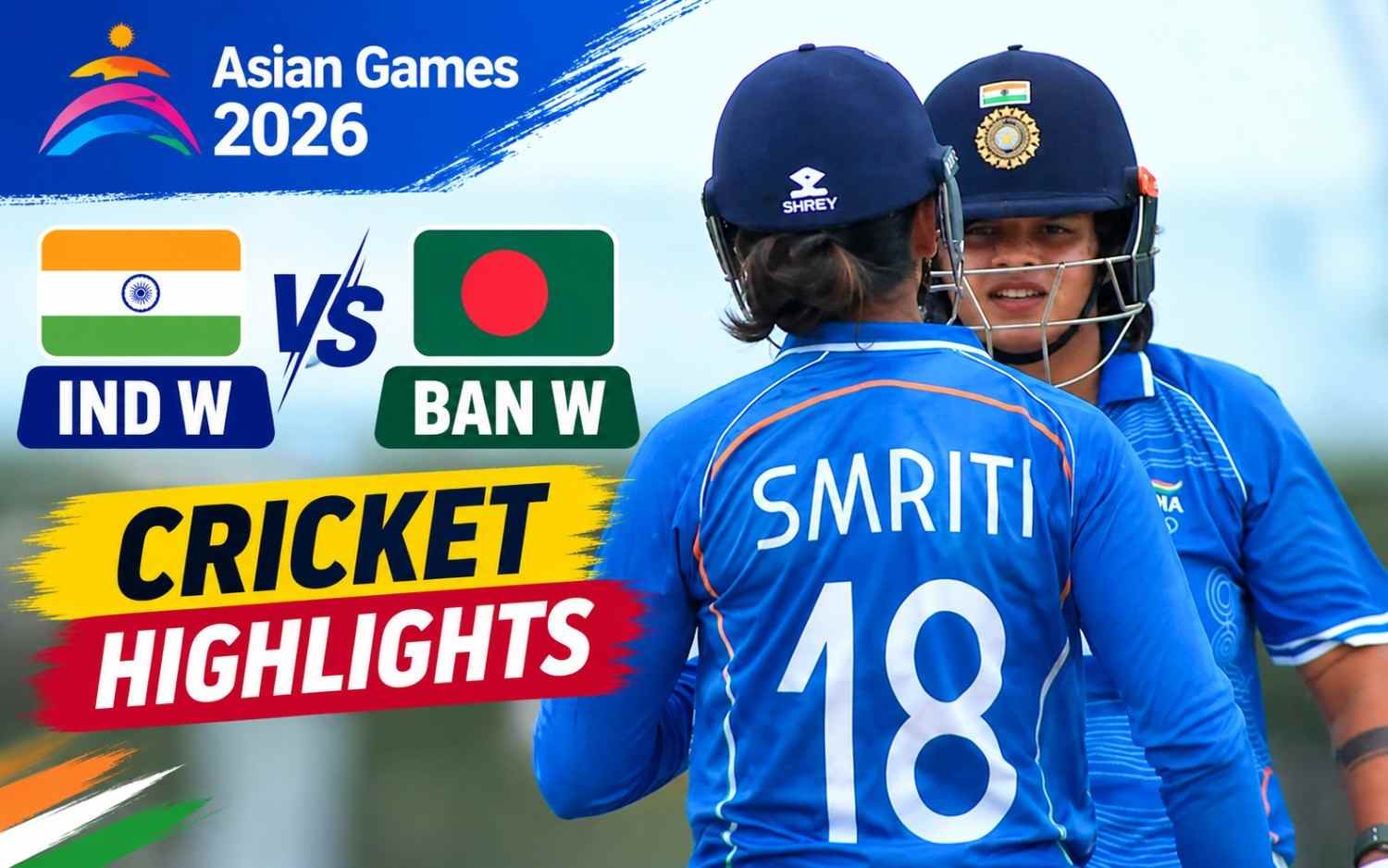
IND W vs BAN W | Cricket Highlights | Asian Games 2026
Match Summary
| Match Detail | Information |
|---|---|
| Match/Tournament Name | Asian Games Women’s Cricket Competition 2026 – 2nd Semi-Final |
| Teams | India Women vs Bangladesh Women |
| Date & Venue | 20 September 2026 – Korogi Sports Park, Nisshin, Japan |
| Format | Women’s T20 |
| India Captain | Harmanpreet Kaur |
| Bangladesh Captain | Nigar Sultana |
| India Head Coach | Amol Muzumdar |
| Bangladesh Head Coach | Sarwar Imran |
| Key Performer | Shafali Verma – 100* off 49 balls |
| Best Bowling Performances | Deepti Sharma 3/7; Nandani Sharma 3/25 |
| India Score | 195/4 in 20 overs |
| Bangladesh Score | 81 all out in 15.4 overs |
| Final Result | India Women won by 114 runs |
| Next Stage | India advanced to the Asian Games gold-medal match |
IND W vs BAN W | Cricket Highlights | Asian Games 2026
IND W vs BAN W | Cricket Highlights | Asian Games 2026
Match Overview & Key Highlights
India Women delivered one of their most emphatic performances of the Asian Games 2026 when they defeated Bangladesh Women by 114 runs in the second semi-final at Korogi Sports Park, Nisshin. The victory secured India a place in the gold-medal match and guaranteed the defending champions another Asian Games medal.
India won the toss and chose to bat first, a decision that immediately paid dividends. The opening pair of Smriti Mandhana and Shafali Verma attacked the Bangladesh bowling from the beginning and established a rapid scoring rate during the powerplay.
Mandhana contributed a superb 37 from only 19 deliveries, while Shafali transformed her excellent start into a historic individual performance. The opener remained unbeaten on 100 from 49 balls, striking three fours and nine sixes.
India eventually finished with 195/4 from their 20 overs, setting Bangladesh a demanding target of 196. Bangladesh needed an exceptional start to remain competitive, but India’s bowling unit quickly turned the contest into a one-sided affair.
The Bangladesh innings never developed the partnerships required for a successful chase. Dilara Akter top-scored with 27, but wickets continued to fall at regular intervals. Deepti Sharma and Nandani Sharma claimed three wickets apiece, while Sree Charani added two as Bangladesh were dismissed for 81 in just 15.4 overs.
First Innings Analysis: Shafali Verma Takes Control
India’s batting innings was built around explosive powerplay batting and Shafali Verma’s extraordinary finishing ability.
Smriti Mandhana and Shafali immediately placed pressure on Bangladesh’s bowlers. The opening partnership produced 72 runs in the powerplay, giving India the ideal platform for a major total.
Mandhana was particularly aggressive, scoring 37 from 19 deliveries with five fours and two sixes. Her innings also carried major historical significance as she moved past Suzie Bates to become the leading run-scorer in women’s T20I cricket.
After Mandhana’s dismissal, G. Kamalini could contribute only three runs from 10 balls, temporarily slowing India’s progress. However, Shafali remained in complete control.
Harmanpreet Kaur then joined Shafali at the crease and provided the experienced support required to build another substantial partnership. The India captain scored 40 from 33 balls, hitting six fours.
The partnership between Shafali and Harmanpreet became the foundation of India’s enormous finish. The pair added 94 runs, allowing India to recover from the loss of Kamalini and accelerate strongly through the latter stages.
Shafali’s batting was particularly destructive. Her strike rate of more than 204 demonstrated the extraordinary pace at which she scored. Nine sixes were a major feature of her innings, repeatedly taking the pressure away from India’s batting partner and Bangladesh’s bowlers.
Richa Ghosh added only two runs, but Bharti Fulmali’s unbeaten nine from five balls helped India finish strongly. Shafali reached her century on the final ball of the innings, completing an unforgettable 100 not out from 49 deliveries.
The final score of 195/4 gave India an excellent platform and placed enormous pressure on Bangladesh before the chase even began.
Turning Point & Crucial Performances
The decisive turning point was undoubtedly Shafali Verma’s unbeaten century.
Her innings combined timing, power and aggressive intent. Rather than simply accumulating runs, Shafali repeatedly attacked the Bangladesh bowlers whenever they offered scoring opportunities. Her nine sixes ensured that India’s run rate remained extremely high throughout the second half of the innings.
Shafali’s hundred was also historically significant. She became the first woman to score a century in Asian Games cricket and recorded her maiden T20I hundred. Her 100 off 49 balls also matched Harmanpreet Kaur’s record for the fastest T20I century by an Indian woman.
Smriti Mandhana’s contribution was equally important in establishing the momentum. Her 37 from 19 balls ensured India made full use of the powerplay, while her achievement of becoming the leading run-scorer in women’s T20Is added another major statistical milestone to the contest.
Harmanpreet Kaur then played the perfect supporting role. Her 40 from 33 balls was less explosive than Shafali’s effort but crucial because it allowed India to maintain a strong scoring rate after the early wickets.
Bangladesh’s bowlers did manage to take four wickets. Nahida Akter dismissed Mandhana, while Sanjida Akter Meghla, Rabeya Khan and Marufa Akter also claimed wickets. However, they could not prevent India from reaching 195.
The real collapse came during Bangladesh’s chase.
Deepti Sharma once again proved why she remains one of India’s most influential all-rounders. She finished with 3/7, using her control and variations to prevent Bangladesh from establishing partnerships.
Nandani Sharma was equally effective. Her 3/25 included important breakthroughs that kept Bangladesh under constant pressure.
Sree Charani also contributed two wickets, while Kranti Gaud and Shreyanka Patil claimed one wicket each. One of the most impressive aspects of India’s bowling performance was its collective nature: Bangladesh never found a bowler they could consistently target.
Dilara Akter provided Bangladesh’s highest individual score with 27, but there was no substantial partnership around her. Nigar Sultana, Nahida Akter, Rabeya Khan, Shorna Akter, Sobhana Mostary and the rest of the Bangladesh batting order were unable to withstand India’s disciplined attack.
India’s fielding and bowling pressure ensured that the required scoring rate quickly became unrealistic.
Second Innings & Tactical Breakdown
Bangladesh began the chase knowing that 196 represented an extremely difficult target. Their primary objective needed to be a strong powerplay followed by the preservation of wickets.
Instead, India’s bowlers prevented Bangladesh from establishing any rhythm.
The Indian attack used a combination of pace and spin to create pressure from both ends. Deepti Sharma’s accuracy made it difficult for Bangladesh’s middle order to rotate the strike freely, while Nandani Sharma supplied wicket-taking pace.
Sree Charani added further control through spin, ensuring Bangladesh could not recover during the middle overs.
The tactical difference between the two sides became increasingly clear. India had already created a deep batting platform through Mandhana, Shafali and Harmanpreet. Bangladesh, by contrast, needed multiple substantial partnerships but lost wickets too frequently.
Once Bangladesh slipped behind the required run rate, India could attack with more aggressive fields. The pressure eventually resulted in a complete collapse, with Bangladesh bowled out for only 81 in 15.4 overs.
The 114-run margin demonstrated how comprehensively India controlled both innings.
Key Statistics & Milestone Records
- India: 195/4 in 20 overs.
- Bangladesh: 81 all out in 15.4 overs.
- Result: India won by 114 runs.
- Shafali Verma: 100* from 49 balls, including three fours and nine sixes.
- Smriti Mandhana: 37 from 19 balls, including five fours and two sixes.
- Harmanpreet Kaur: 40 from 33 balls with six fours.
- Deepti Sharma: 3/7.
- Nandani Sharma: 3/25.
- Sree Charani: 2/7.
- Dilara Akter: Bangladesh’s leading scorer with 27.
- Shafali became the first woman to score a century at the Asian Games.
- Shafali also recorded her maiden T20I century.
- Shafali’s nine sixes took her women’s T20I six tally to 104.
- Smriti Mandhana became the leading run-scorer in women’s T20I cricket.
- India recorded a 114-run victory, their biggest win by runs against a full-member nation in women’s T20Is.
- India reached the Asian Games women’s cricket final for the second successive edition.
Post-Match Impact & What’s Next
India’s emphatic victory over Bangladesh secured their place in the Asian Games 2026 women’s cricket gold-medal match. The result also guaranteed India at least a silver medal in the competition.
For Harmanpreet Kaur, Amol Muzumdar and the Indian squad, the immediate focus now turns to the final against Sri Lanka. Sri Lanka also reached the gold-medal match after defeating Pakistan in their semi-final.
Bangladesh’s Asian Games campaign will continue in the bronze-medal match against Pakistan. For Nigar Sultana’s side, the defeat highlighted the need for greater batting consistency against a high-quality bowling attack.
India, meanwhile, will enter the final carrying significant momentum after the combination of Shafali Verma’s historic century and a devastating collective bowling performance. The semi-final showed India’s ability to win through both explosive batting and disciplined bowling, setting up a major contest for Asian Games gold.
The core match facts are supported by the official tournament/scorecard reporting and major match reports: India made 195/4, Bangladesh were dismissed for 81, Shafali Verma scored 100* from 49 balls, and Deepti Sharma and Nandani Sharma took three wickets each. ESPN Cricinfo India’s coaching staff and Bangladesh’s Sarwar Imran-led support staff are also listed in the tournament squad information.