
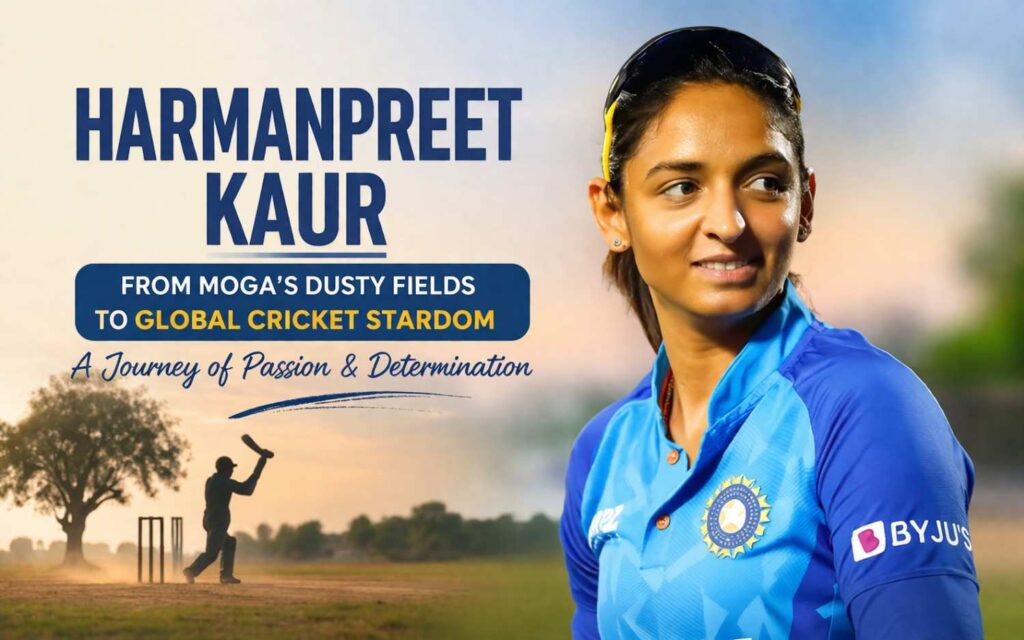
In the world of Indian women’s cricket, few names evoke as much pride, power, and inspiration as Harmanpreet Kaur. Born on International Women’s Day, she didn’t just play the game—she redefined it for millions of girls across India. Drawing from the inspiring Hindi biography video by CricBlaze, this article traces her remarkable journey from a small-town girl in Punjab to the captain of the Indian Women’s National Cricket Team in all formats. It’s a tale of raw talent, relentless hard work, family support, and breaking barriers in a male-dominated sport.
Early Life: A Sport-Loving Girl from Moga
Harmanpreet Kaur Bhullar was born on March 8, 1989, in Moga, Punjab, into a lower-middle-class family. Her father, Harminder Singh Bhullar, was a state-level basketball player and club cricketer who instilled a deep love for sports in her from day one—he even gifted her a “Good Batsman” T-shirt on her birth! Her mother, Satinder Kaur, a housewife, supported the family amid the challenges of raising a sports-enthusiast daughter.
From a young age, Harmanpreet was drawn to sports. She played hockey using a cricket bat, challenged boys in the neighborhood to hit massive sixes, and idolized Virender Sehwag for his fearless batting. School teachers often scolded her parents for encouraging her to play “a boys’ game,” but the family stood firm. She studied at Gyan Jyoti Senior Secondary School in Moga, where her passion only grew stronger.
Discovery by a Coach: The Turning Point
In 2006, while in 10th grade, fate intervened. Coach Kamal Deesh Sodhi spotted her smashing long sixes while playing with boys in a scarf-turned-makeshift pad. Recognizing her immense talent, he offered to cover all her cricket training expenses— a godsend for a family that couldn’t afford academy fees.
Training was tough but transformative. Armed with a worn-out bat and a seamless ball, Harmanpreet would hit half the deliveries out of the ground, using a mango tree as the boundary marker for sixes. At just 16, she joined SK Public School in Ferozepur as a finisher batsman and medium-fast bowler. Her consistent performances in school and district teams earned her a spot in the Punjab Cricket Association camp, where she trained alongside the state’s best players.
Within two years, she was knocking on the doors of the Punjab senior team. Though she didn’t break through immediately, her dedication never wavered.
International Debut: Stepping onto the Big Stage
Harmanpreet’s big break came in 2007 during the Under-19 Inter-Zonal One Day Competition. Former Indian captain Anju Jain, then on the BCCI selection committee, noticed her aggressive style and selected her for the 2009 U-19 World Cup squad. Jain was looking for a fearless six-hitter, and Harmanpreet delivered with an impressive average of 37 and strike rate of 59.2 across four innings.
She trained at the National Cricket Academy in Bangalore alongside 29 other probables. At just 19, she made her ODI debut on March 7, 2009, against Pakistan in the World Cup—realizing her dream on the biggest stage. Her T20I debut followed on June 11, 2009, against England in the T20 World Cup.
Early opportunities were limited. She bowled sparingly due to legends like Jhulan Goswami and Amita Sharma, and batting chances were scarce. But she adapted, shifting focus to becoming a reliable long-innings batsman while preserving her natural aggressive game, inspired by coaches like Yadavindra Singh Sodhi.
Challenges on the Path to Glory
The road wasn’t easy. Women’s cricket lacked the popularity and support it enjoys today. Harmanpreet faced rejection, including a 2012 Railways job application turned down partly due to gender biases. Recognition came slowly despite strong domestic performances. Yet, these hurdles only fueled her determination.
Breakthroughs and Iconic Achievements
Harmanpreet’s career exploded with several defining moments:
- 2012 T20 Asia Cup: At age 23, she captained the team in Mithali Raj’s absence and defended a low total of 81 to win by 18 runs—her first taste of leadership success.
- Test Debut: August 13, 2014, against England.
- Dominance in 2014: She claimed 9 wickets in a Test against South Africa, helping India secure an innings-and-34-run victory.
- 2016 WT20: 89 runs and 7 wickets across four matches showcased her all-round prowess.
- 2017 Women’s World Cup Semi-Final: Her unbeaten knock against Australia (watched by over 125 crore Indians) announced her arrival on the global stage. She became the first Indian woman to play in the Women’s Big Bash League (WBBL) and received the Arjuna Award that year.
- T20 Captaincy and Century: Appointed T20I captain in 2018, she slammed a blazing 103 off just 51 balls against New Zealand—India’s first women’s T20I century, featuring 7 fours and 8 sixes.
After Mithali Raj’s retirement following the 2022 World Cup, Harmanpreet took over as captain across all formats. Her leadership has elevated the team’s fortunes, inspiring a new generation.
Leadership, Legacy, and Inspiration
Today, Harmanpreet Kaur stands as a symbol of empowerment. The video beautifully captures her evolution: from a scarf-wearing girl hitting sixes in Moga to a world-class all-rounder and captain who changed the narrative for Indian women’s cricket.
Her story teaches that limits exist only in our minds. “Girls can achieve anything they set their mind to,” it emphasizes. Born on Women’s Day, she became an inspiration for countless young girls chasing their dreams against all odds.
Whether smashing boundaries or leading her team with grit, Harmanpreet embodies Punjab’s fighting spirit and India’s rising women’s cricket revolution. Her journey reminds us: with passion, support, and unyielding resolve, even the smallest villages can produce global champions.
Watch the full inspiring video on YouTube by CricBlaze for the complete narrative in Hindi. What’s your favorite Harmanpreet Kaur moment? Share in the comments below!