The trajectory of Imran Khan’s life is one of the most remarkable modern political and biographical narratives in South Asia. From towering athletic achievements on the international cricket pitch to philanthropic milestones, and ultimately to high-stakes political office followed by imprisonment, his journey resembles a classic Greek tragedy—an ascent to the pinnacle of power matched by an equally dramatic descent,.
1. Early Life, Education, and Athletic Beginnings
Born on October 5, 1952, in Lahore into an affluent, educated Pashtun family of the Niazi tribe, Imran Khan was surrounded by a sporting legacy,. His early education took place at the prestigious Aitchison College in Lahore before he moved to England, attending the Royal Grammar School Worcester and later securing admission to Keble College, Oxford, where he studied Philosophy, Politics, and Economics (PPE),.
By the age of 18, Khan had made his first-class cricket debut, and on June 3, 1971, he debuted for the Pakistan national cricket team against England. Initially viewed as an ordinary fast-medium bowler, grueling physical conditioning, relentless determination, and an aggressive, fearless attitude transformed him into one of the world’s premier all-rounders and fast bowlers,.
2. The 1992 World Cup Glory and Philanthropic Vision
By 1982, Khan was named captain of the Pakistan cricket team. His leadership style was authoritative and fiercely competitive, fostering a winning culture that introduced legendary players like Wasim Akram to international cricket.
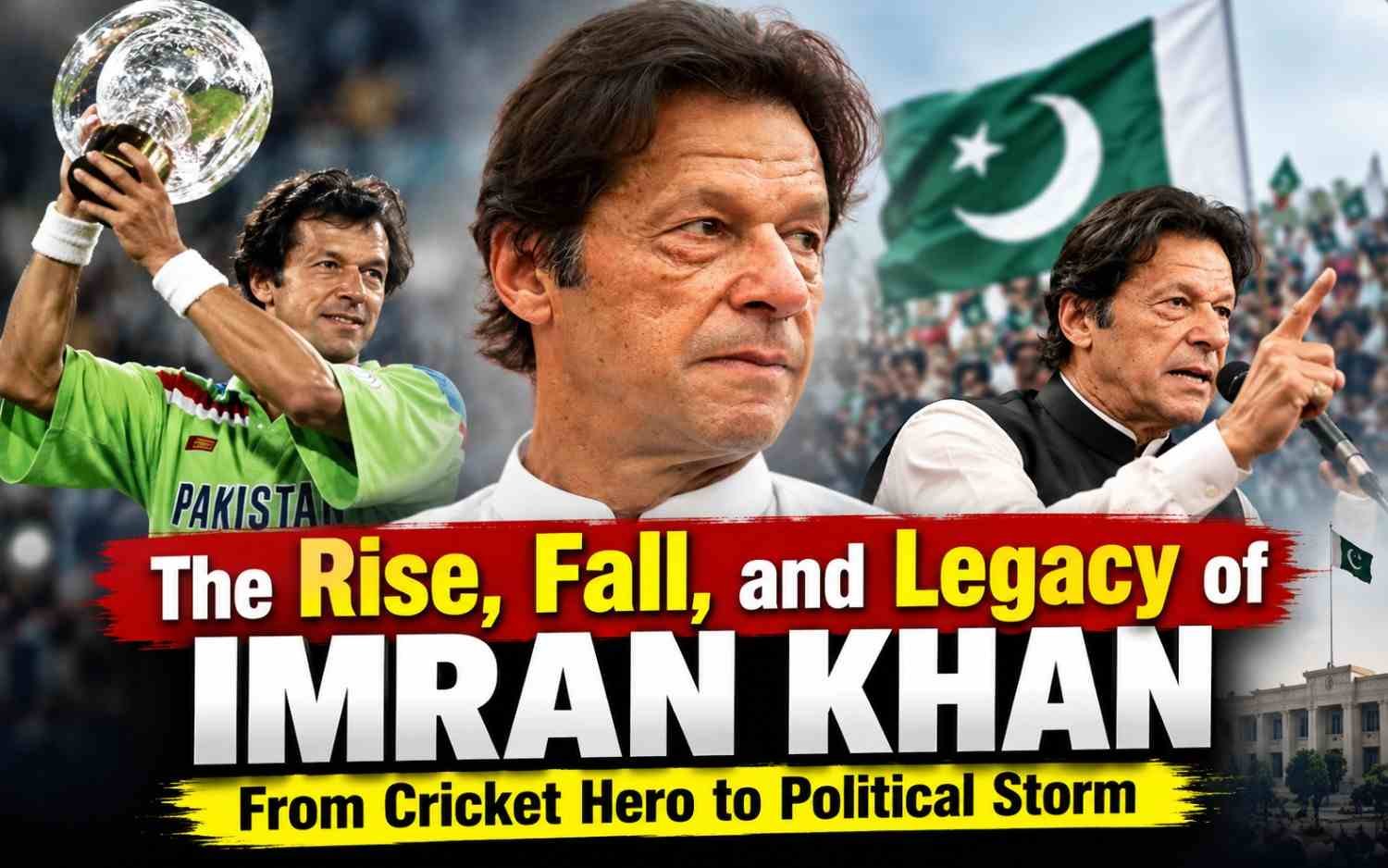
The defining moment of his sporting career came on March 25, 1992, at the Melbourne Cricket Ground in Australia, where he led Pakistan to their first and only Cricket World Cup victory, scoring a team-high 72 runs in the final,.
However, his victory speech signaled a profound shift away from sports. Driven by the personal tragedy of losing his mother, Shaukat Khanum, to cancer in 1985, Khan dedicated his post-victory mission to establishing Pakistan’s first state-of-the-art, charitable cancer hospital,. Despite immense bureaucratic hurdles and financial skepticism, he traversed the country, successfully raising funds from ordinary citizens to open the Shaukat Khanum Memorial Cancer Hospital in Lahore in December 1994,.
3. Entry into Politics and the Long Road to Power
Encouraged by the grass-roots connection he forged during his hospital fundraising campaigns, Khan entered the political arena in April 1996 by founding Pakistan Tehreek-e-Insaf (PTI), centered on platforms of anti-corruption, justice, and human dignity,.
For over two decades, PTI struggled to gain electoral momentum, often dismissed by critics as a minor political player. However, leveraging social media, appealing directly to Pakistan’s tech-savvy youth and urban middle class, and capitalizing on public disillusionment with traditional political dynasties (such as the Pakistan Muslim League-N and Pakistan Peoples Party), Khan gradually built a massive political base.
In the July 2018 general elections, PTI emerged as the single largest party, leading to Imran Khan being sworn in as Pakistan’s Prime Minister. His administration initiated notable social welfare schemes, including the Ehsaas program and the Sehat Sahulat health insurance initiative,.
4. The Turning Point: Rift with the Military Establishment and Downfall
Khan’s tenure as Prime Minister was severely tested by shifting geopolitical dynamics and domestic friction. Observers note that while his initial rise to power enjoyed tacit backing from Pakistan’s powerful military establishment (the General Headquarters in Rawalpindi), tensions soon flared over civil-military command, intelligence appointments, and foreign policy independence,.
Disagreements over key security appointments and an independent foreign policy stance—exemplified by his diplomatic engagements and refusal to align unconditionally with Western strategic demands—strained relations with the military leadership,.
In April 2022, Khan lost a parliamentary vote of confidence, leading to the collapse of his government. Following his ouster, he faced a barrage of over 100 legal charges, ranging from corruption allegations tied to the Al-Qadir Trust and the Toshakhana gifts case to terrorism and sedition charges,.
5. Arrest, Public Backlash, and Current Standing
The political crisis escalated dramatically when Khan was arrested inside the Islamabad High Court in May 2023, triggering widespread street protests and unprecedented public demonstrations outside military installations,.
Subsequent legal battles, brief releases, and ongoing imprisonment at Adiala Jail in Rawalpindi have turned him into a polarizing and resilient symbol of defiance against institutional power,. Despite being barred from holding public office and facing continued legal hurdles, PTI loyalists and his support base remain a potent force in Pakistani politics.
References:
- Link 1: The Real Story of Imran Khan You Don’t Know ft. Mukul | Jist
- Link 2: Imran Khan vs Pakistan Army | Who will Win? | Dhruv Rathee
- Link 3: Story of Imran Khan – Gyro Sulcus
- Link 4: Imran Khan Biography | From Cricket to Politics | RealTV
Conclusion
Imran Khan’s journey—from lifting the World Cup trophy in Melbourne to navigating the labyrinth of Pakistani politics, challenging entrenched military power, and enduring solitary confinement—remains one of the most closely watched chapters in contemporary international relations,. Whether his political chapter is permanently closed or poised for an unexpected resurgence remains one of the defining questions of the region’s political future.