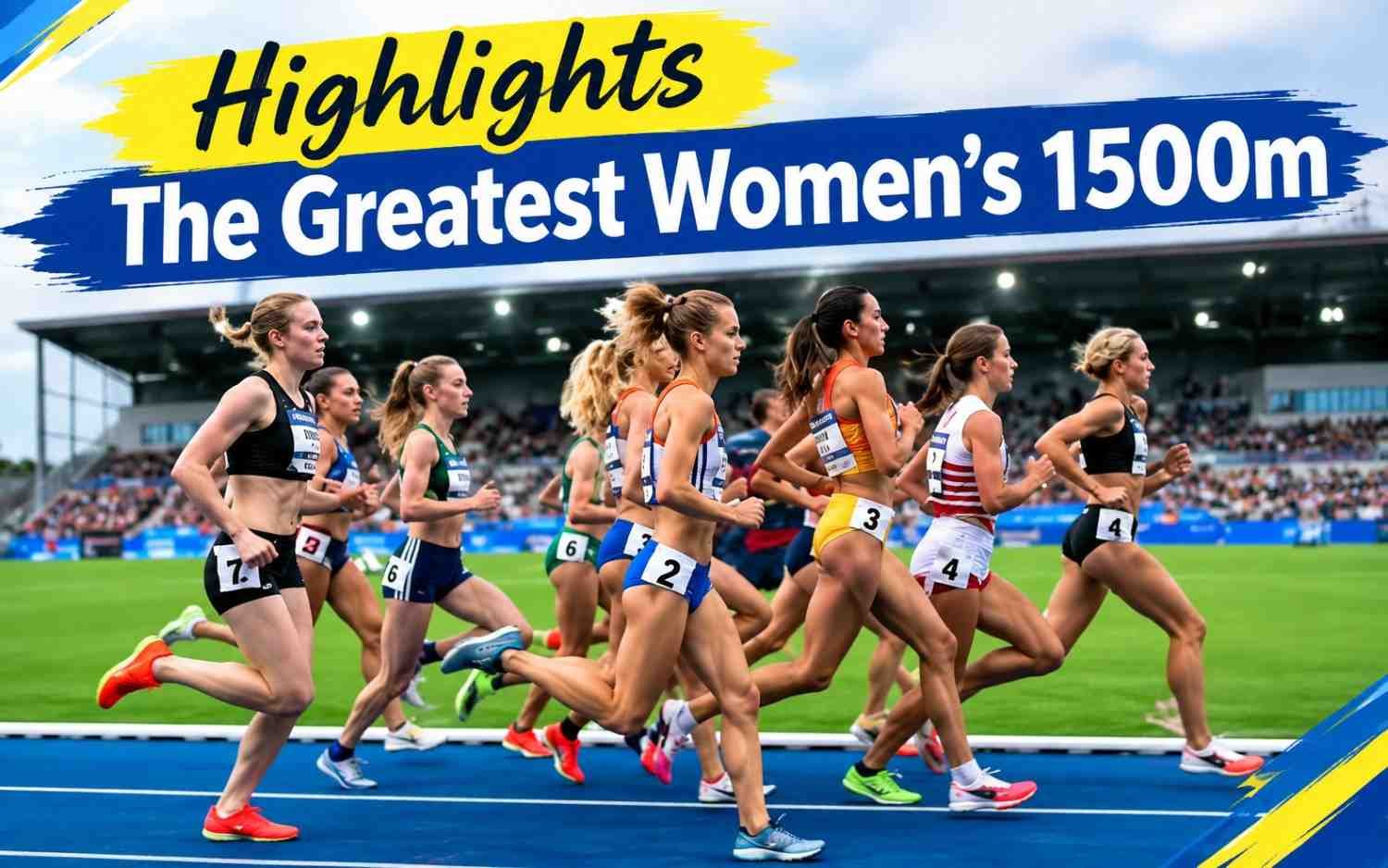
Highlights – The Greatest Women’s 1500m
Event Summary
| Event Parameter | Details |
| Tournament Name | World University Games (Women’s 1500m Final) |
| Key Athletes Involved | Joselyn Wind, Sarah Calvert, Kimberly May, Marina Martinez Ortuno, Armina Martuk, Rosa Twford, Gina Lernes |
| Date & Venue | September 2026 / International University Athletics Championships Venue |
| Key Performers / Winner | Joselyn Wind (Gold Medalist), Sarah Calvert (Silver Medalist), Kimberly May (Bronze Medalist) |
| Final Result / Summary | Joselyn Wind timed her final surge perfectly to win gold with a time of 4:19.96, edging out Sarah Calvert and Kimberly May. |
Highlights – The Greatest Women’s 1500m
Match Overview & Key Highlights
The stage was set for an extraordinary tactical battle as elite middle-distance runners converged for the Women’s 1500m final at the World University Games. The atmosphere crackled with high stakes and nervous energy, as athletes from across the globe prepared to test their physical limits and strategic acumen. Team combinations featured top-tier collegiate champions and seasoned national titleholders, creating a volatile mix of raw speed and tactical experience.
The race began under watchful eyes, with the competitors testing each other’s patience from the opening gun. Rather than bursting out of the blocks with aggressive, record-chasing velocities, the field opted for an uncharacteristically conservative tempo. This hesitation at the front transformed the early stages into a psychological chess match. Every runner was acutely aware that a single misstep or a premature surge could drain vital energy reserves needed for the inevitable closing sprint. The crowd held its breath as the pack bunched tightly together, setting the stage for a dramatic second half.
First Half / Innings Analysis
As the athletes crossed the start-finish line for the initial laps, the pace surprised spectators and commentators alike. The opening 400-meter split clocked in at a sluggish 70 seconds—a stark contrast to the blistering 63-to-65-second opening laps typical of fast championship races. Nobody wanted to shoulder the burden of leading into the teeth of the wind, causing the pack to bunch up aggressively three runners wide.
This cautious pacing created an unexpected tactical dilemma. In a slow race, standard logic suggests runners should spread out to conserve breathing space and maintain fluid mechanics. Instead, the field tightened significantly. Each competitor understood that when the inevitable late-race kick arrived, inside position would dictate survival. Runners like Great Britain’s Sarah Calvert, representing the University of Edinburgh and entering as a 4:08 performer, found themselves jostling for real estate in the middle pockets. Meanwhile, Norway’s Gina Lernes and Dutch competitor Armina Martuk floated near the front without establishing a dominant rhythm. The first half was defined by defensive positioning, lane protection, and an underlying tension as everyone waited for someone else to make the first mistake.
Turning Point & Crucial Performances
The definitive turning point of the race arrived during the bell lap, transforming a tense tactical stalemate into an explosive sprint finish. As the bell rang, Armina Martuk and Spain’s Marina Martinez Ortuno tried to control the tempo, but the pack began to unravel. Sarah Calvert, trapped in a dangerous middle pocket three runners deep, faced a critical decision. To escape the box, Calvert executed a wide lateral move around the outside of two competitors. While this aggressive maneuver successfully improved her track position, it forced her to cover extra distance—a costly choice that drained her glycolytic reserves right before the final straightaway.
As Calvert surged forward with driving arms and a cadence climbing toward 3.8 steps per second, she briefly appeared to seize control of the race. However, Switzerland’s Joselyn Wind executed a masterclass in energy conservation. Wind, a 23-year-old Swiss national champion with prior World Championship experience, avoided the chaotic lateral scrambles that plagued her rivals. While Calvert burned crucial energy on the back straight, Wind maintained a smooth, controlled position just off the shoulder of the leaders.
Waiting patiently until Calvert’s legs began running on fumes from her wide maneuver, Wind unleashed a devastating, perfectly timed kick. Rounding the final bend, Wind accelerated past the fading front-runners with a clean line and fresh reserves. Her brilliant execution carried her across the finish line to claim the gold medal, leaving Calvert to bravely hold on for the silver and New Zealand’s Kimberly May to secure a hard-earned bronze.
Second Half / Final Overs / Tactical Breakdown
Analyzing the final 200 meters reveals the fine margins that separate gold from silver in elite middle-distance racing. The closing stretch of a championship 1500m typically unfolds at high velocity, requiring athletes to maintain powerful stride mechanics under severe oxygen debt. Calvert’s strategy relied on early acceleration and raw aerobic capacity, but her wide tactical line on the back straight compromised her finishing efficiency.
In contrast, Joselyn Wind’s second-half strategy prioritized positional discipline and energy management. By refusing to panic during the mid-race crowding, Wind preserved her anaerobic capacity for the precise moment it mattered most. Her stride length remained well-optimized through the final bend, allowing her to transition smoothly into her closing sprint without suffering the sudden deceleration that caught out other contenders. This tactical maturity underscores why championship races are rarely won by pure top speed alone; they are conquered by the athlete who spends the least amount of energy before the final 100 meters.
Key Statistics & Milestone Records
- Winning Time: Joselyn Wind crossed the finish line in [05:12] with a gold-medal-winning time of 4:19.96.
- Podium Finishers: Joselyn Wind (Gold, Switzerland), Sarah Calvert (Silver, Great Britain), and Kimberly May (Bronze, New Zealand).
- Opening Lap Split: The conservative tactical start produced an opening 400m split of approximately 70 seconds.
- Cadence Metrics: Front-runners pushed their stride frequency to between 3.6 and 3.8 steps per second during the frantic closing straightaway.
- Athlete Backgrounds: Joselyn Wind entered as a four-time Swiss national champion; Sarah Calvert competed as the British Universities champion with a personal best of 4:08.
Post-Match Impact & What’s Next
This thrilling World University Games final will be studied by coaches and athletes for years as a textbook demonstration of championship racing tactics. For Joselyn Wind, the gold medal validates her international potential and cements her status as a rising star in Swiss athletics. For Sarah Calvert and Kimberly May, the performance provides valuable championship experience and highlights areas for tactical refinement in future international showdowns.
As the athletics calendar moves forward, these competitors will take crucial lessons in energy distribution and positioning back to their respective collegiate and national training camps, setting the stage for even faster and more tactical showdowns on the global track circuit.