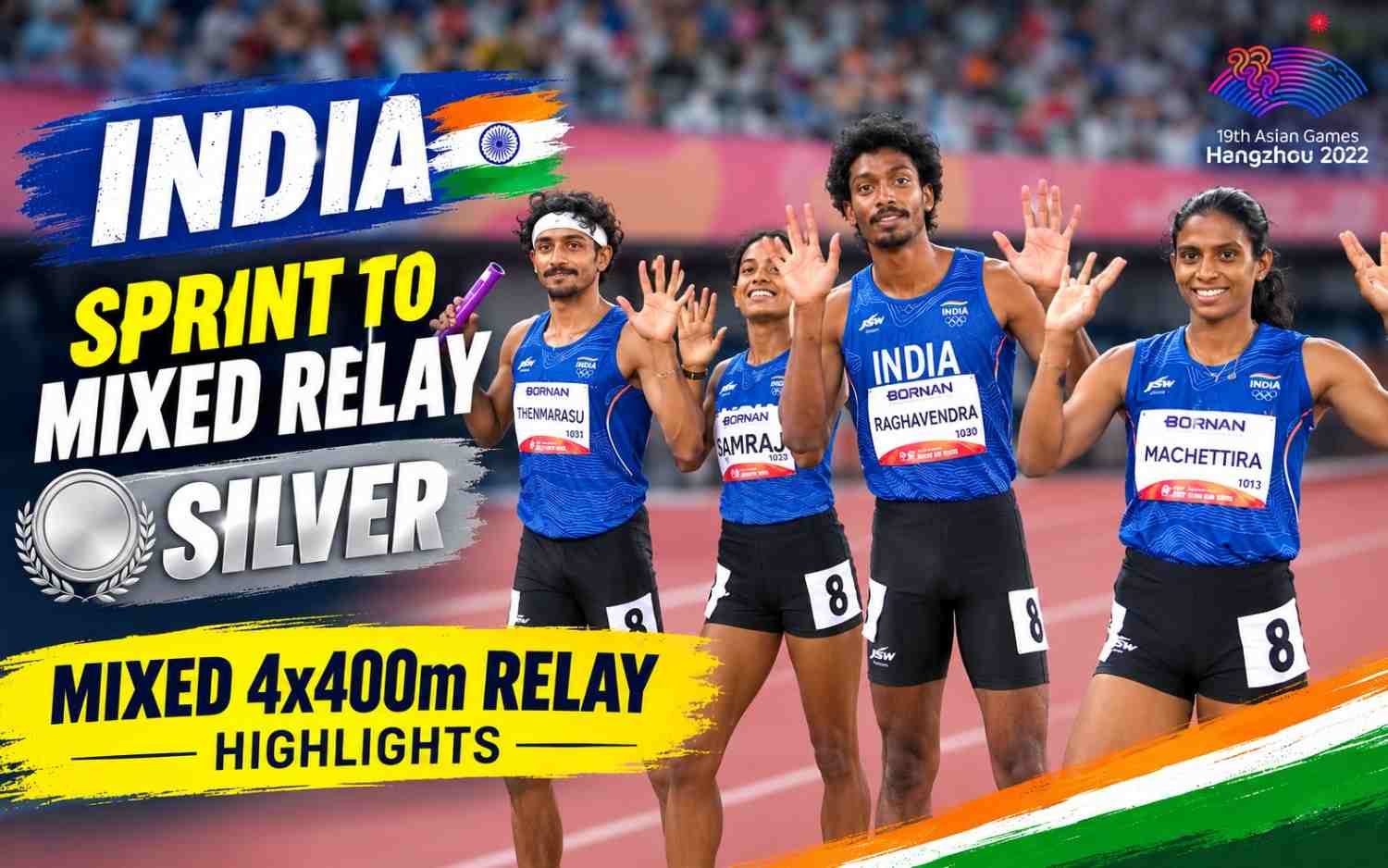
India Sprint To Mixed Relay Silver | Mixed 4x400m Relay – Highlights
Event Summary
| Event Attribute | Details & Specifications |
| Tournament & Event | Asian Games 2026 – Athletics (Mixed 4x400m Relay Final) |
| Teams Involved | India, Bahrain, Vietnam, China, Japan, UAE, among others |
| Date & Venue | September 24, 2026 |
| Key Performers | Vithya Ramraj (IND – Anchor Leg), M. R. Poovamma (IND), Salwa Eid Naser (BAH) |
| Final Result & Medals | Gold: Bahrain (3:12.87 – GR) | Silver: India (3:14.46) | Bronze: Vietnam (3:14.54) |
India Sprint To Mixed Relay Silver | Mixed 4x400m Relay – Highlights
Match Overview & Key Highlights
The track and field events at the Asian Games 2026 delivered high drama and electric atmospheres as Asia’s finest track athletes clashed at the Nagoya City Mizuho Park Athletic Stadium in Japan. Among the most anticipated track events on the continental program was the Mixed 4x400m Relay—a tactical, high-speed discipline blending tactical discipline, precise baton exchanges, and sheer endurance.
Entering the final, team India carried high expectations and significant pressure. India had historically been a powerhouse in the continental 4x400m disciplines, having claimed silver in the mixed relay at the 2023 Hangzhou Games. However, competition in 2026 reached an unprecedented level. Heavyweights Bahrain fielded a world-class squad, while emerging sprinting forces from Vietnam, Japan, and China possessed deep rosters capable of snatching podium finishes.
Drawn in Lane 7, the Indian squad featured an ideal blend of youth and veteran experience. The quartet comprised Vishal Thennarasu, veteran quarter-miler M. R. Poovamma, Manu Thekkinalil (Manu T.S.), and anchor specialist Vithya Ramraj. Facing stiff competition from Bahrain and a surging Vietnamese quartet, India produced a tactically sound, heroic comeback effort to storm across the finish line in 3:14.46, clinching a spectacular Silver Medal for the nation.
First Half / Early Relay Legs Analysis
The final got underway under brilliant stadium lights, with all eight lanes launching into high-gear strides as the gun fired. The opening 400-meter leg proved intensely competitive, setting a blistering pace across the track.
Leg 1: The Opening Charge
Vishal Thennarasu kicked off the opening leg for India from outer Lane 7. Tasked with establishing early positioning before the runners merged after the staggered turn, Vishal faced immediate pressure from Bahrain and UAE. Bahrain’s lead runner exploded out of the blocks, setting a ferocious early pace to pull away from the pack. Vishal ran a controlled, steady race, ensuring India stayed within striking distance despite battling wide turns. As the runners consolidated into the inner lanes passing the red marker cones, India found themselves hovering around fifth position, trailing early pacesetters UAE, Bahrain, and China.
Leg 2: Poovamma’s Veteran Resilience
As the first baton exchange area approached, Vishal executed a clean handoff to veteran quarter-miler M. R. Poovamma. Known for her tactical intelligence and experience in multiple Asian Games gold-winning relays, Poovamma immediately went to work. Over the next 400 meters, she displayed remarkable pacing. As competitors from Vietnam and China pushed hard along the back straight, Poovamma held her line, conserving energy for the home stretch. Coming out of the final bend, Poovamma launched a decisive burst over the last 50 meters, passing struggling runners to haul India back into top-four contention before handing off to Manu T.S.
Turning Point & Crucial Performances
While the first two legs established a stable foundation, the third and fourth legs provided the ultimate turning point that dictated the medal distribution.
Leg 3: Manu T.S. Holds the Line
Manu T.S. took charge during the third leg, navigating an intense mid-race battle. With Bahrain firmly out in front building a commanding lead, the battle for silver and bronze turned into a chaotic three-way tussle between India, Vietnam, and Japan. Manu showed grit along the back straight, absorbing pressure from Vietnam’s Quach Cong Lich. Recognizing the importance of a clean baton pass within the designated 20-meter exchange zone, Manu preserved his form and delivered a smooth, flawless baton transfer to India’s anchor runner, Vithya Ramraj.
The Defining Moment: Vithya’s Explosive Anchor Run
When Vithya Ramraj received the baton for the final 400 meters, India sat in fourth place, trailing Vietnam and Japan, with bronze looking like the best possible outcome. However, Vithya executed one of the finest anchor legs in recent Indian track history:
- Pacing the Backstretch: Instead of panicking and burning energy early, Vithya lengthened her stride, steadily closing a gap of nearly eight meters on third-place Japan.
- The Final Curve Surge: Rounding the final bend into the home straight, Vithya swung wide, accelerating past the Japanese anchor to move firmly into the bronze position.
- The Silver Dip: With 40 meters remaining, Vithya locked eyes on Vietnam’s anchor runner. Digging deep with immense physical determination, Vithya surged past Vietnam in the final strides, crossing the finish line in second place to lock in the Silver medal.
Tactical Breakdown & Final Lap Analysis
Relay victories are won not just on raw speed, but through flawless tactical execution and baton exchange mechanics. The Indian coaching staff made strategic adjustments between the qualifying heats and the grand final. In the heats, the squad had utilized Kiran and Jay Kumar alongside Poovamma and Manu, clocking a solid 3:16.23 to qualify comfortably.
For the final, introducing fresh legs in Vishal Thennarasu and anchoring with Vithya Ramraj proved to be a tactical masterstroke.
                                RELAY FINAL TIMINGS
┌─────────────────────────┬─────────────────────────────┬─────────────────┐
│ Team                    │ Time (m:s)                  │ Medal           │
├─────────────────────────┼─────────────────────────────┼─────────────────┤
│ Bahrain                 │ 3:12.87                     │ Gold (GR)       │
│ India                   │ 3:14.46                     │ Silver          │
│ Vietnam                 │ 3:14.54                     │ Bronze          │
└─────────────────────────┴─────────────────────────────┴─────────────────┘
Bahrain operated in a league of their own, anchored by former world champion Salwa Eid Naser, crossing the line in 3:12.87 to set a new Asian Games Record. However, the tactical fight behind them showcased India’s superior race execution. Vithya Ramraj’s split timing in the anchor leg was crucial; her ability to maintain speed through the lactic acid wall over the final 100 meters allowed India (3:14.46) to edge out Vietnam (3:14.54) by a mere 0.08 seconds.
Key Statistics & Milestone Records
The Silver medal victory produced several notable statistical milestones for Indian athletics on the continental stage:
- Official Podium Time: India posted a season-best timing of 3:14.46 in the final.
- Winning Margin: India edged out Bronze medalists Vietnam (3:14.54) by just 0.08 seconds, demonstrating incredible clutch sprinting in the final stretch.
- Games Record Broken: Gold medalist Bahrain set a breathtaking new Asian Games Record of 3:12.87.
- Third Consecutive Podium: This result marked India’s third consecutive medal in the Mixed 4x400m Relay at the Asian Games, following Gold in 2018 (Jakarta) and Silver in 2023 (Hangzhou).
- Veteran Legacy: M. R. Poovamma extended her phenomenal Asian Games medal tally, having previously been an integral part of Gold medal-winning quartets in 2014 and 2018.
- Double Medal Night: The relay silver contributed to a memorable evening for Indian athletics at Nagoya, alongside Seema Kumari’s Bronze medal in the women’s 10,000m final (32:50.05).
Post-Match Impact & What’s Next
This thrilling Silver medal performance provides a massive boost to Indian athletics as the continental games progress. Securing a podium finish in the mixed relay reinforces India’s status as an international track powerhouse in 1600m relay disciplines.
The immediate focus now shifts to the individual 400m events, as well as the upcoming Men’s 4x400m and Women’s 4x400m relay competitions. With senior stars like M. R. Poovamma leading by example and dynamic athletes like Vithya Ramraj demonstrating world-class anchoring ability, Indian relay squads carry tremendous momentum heading into the remainder of the Asian Games athletics program.