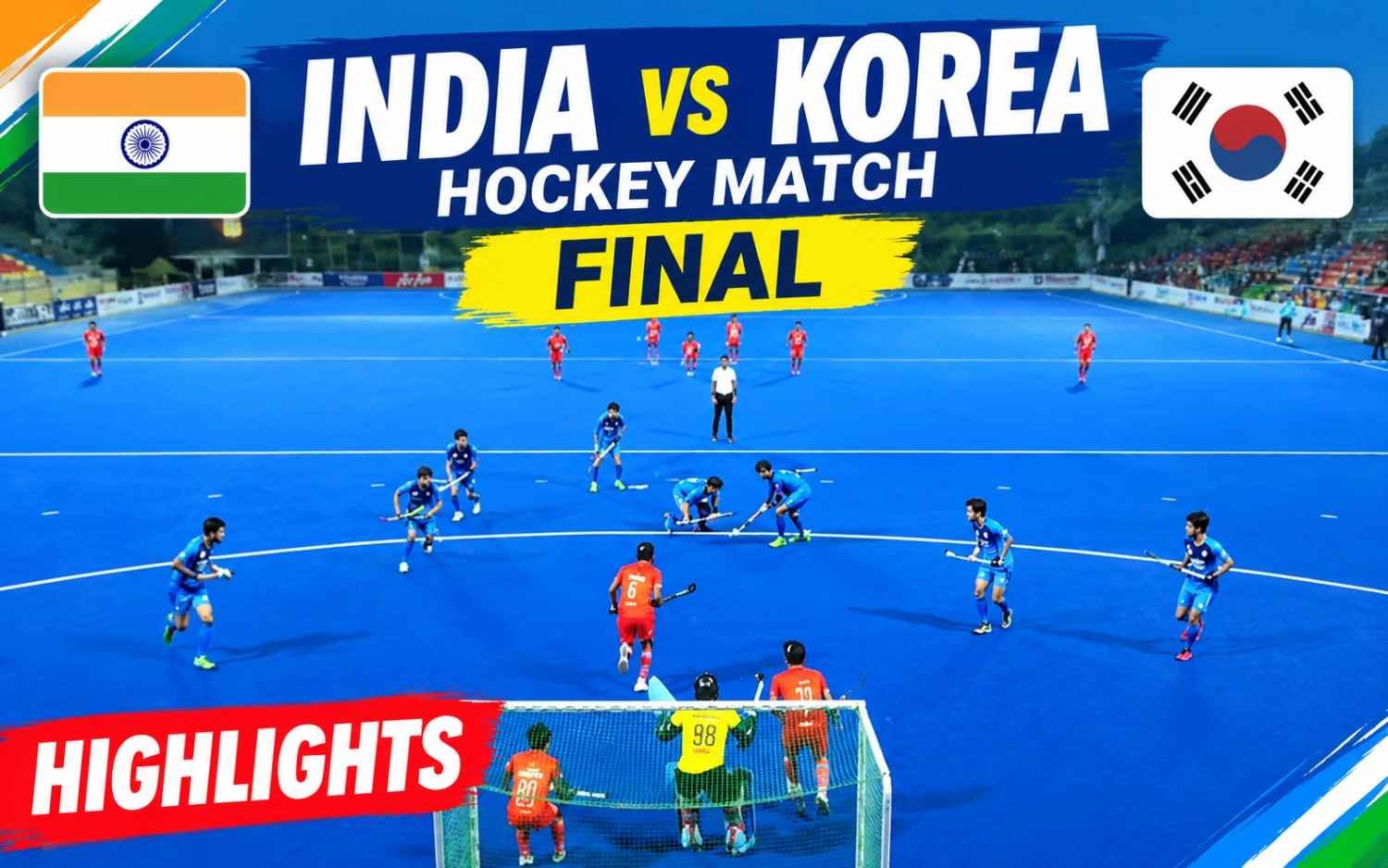
HIGHLIGHTS | India vs Korea Hockey Match | FINAL
Match Summary
| Match Detail | Information |
|---|---|
| Tournament | Men’s Junior Asia Cup 2026 |
| Match | India vs South Korea – Final |
| Date | September 13, 2026 |
| Venue | Moqi Training Base, Moqi, China |
| Final Score | India 4-1 South Korea |
| India Goal Scorers | Ajeet Yadav, Anmol Ekka, Prabhdeep Singh, Ashu Maurya |
| South Korea Goal Scorer | Lee Minhyeok |
| Key Performer | India’s collective attacking and defensive unit |
| Result | India won the Men’s Junior Asia Cup 2026 |
| Qualification Impact | India qualified for the FIH Men’s Junior World Cup |
HIGHLIGHTS | India vs Korea Hockey Match | FINAL
Match Overview & Key Highlights
The India vs Korea Hockey Match Final delivered a commanding performance from the Indian Junior Men’s Hockey Team as India defeated South Korea 4-1 at the Moqi Training Base in China on September 13, 2026. The victory allowed India to successfully defend its continental crown and claim the Men’s Junior Asia Cup title for a record sixth time. (Hockey India)
India entered the final carrying the expectations of a defending champion, but the team responded with an authoritative display from the opening whistle. Rather than allowing South Korea to settle into the contest, India immediately looked to control possession, create pressure inside the attacking circle and force penalty-corner opportunities.
The final ultimately reflected India’s superiority across crucial phases of the game. Ajeet Yadav opened the scoring in the ninth minute, while captain Anmol Ekka doubled the advantage four minutes later. Prabhdeep Singh then added a third goal early in the second quarter, giving India a 3-0 half-time advantage. (Hockey India)
South Korea attempted to respond, but India’s defensive structure remained disciplined. Ashu Maurya added India’s fourth goal in the 50th minute before South Korea captain Lee Minhyeok converted a penalty stroke in the 54th minute.
The final whistle confirmed a 4-1 India victory, completing another memorable chapter in Indian junior hockey.
First Half Analysis: India Establish Complete Control
The opening quarter proved decisive because India established a substantial advantage before South Korea could build any sustained attacking rhythm.
India’s early pressure resulted in a penalty corner with just over seven minutes remaining in the first quarter. South Korea initially managed to defend the opportunity, but India’s persistence produced another attacking chance soon afterward.
The breakthrough arrived in the ninth minute. Ajeet Yadav got the crucial touch through a deflection to put India ahead 1-0. The goal immediately rewarded India’s aggressive start and forced South Korea to alter its defensive approach. (Hockey India)
India did not retreat after taking the lead. Instead, the defending champions continued to press and earned another penalty corner with the opening quarter approaching its conclusion. Captain Anmol Ekka took responsibility and converted in the 13th minute, extending India’s advantage to 2-0.
South Korea earned a penalty corner late in the first quarter and had an opportunity to reduce the deficit. India’s defence, however, remained composed and successfully prevented the Korean attack from finding the target.
India therefore completed the opening 15 minutes with a 2-0 advantage.
The second quarter followed the same pattern. India remained in control and added another goal in the 21st minute, with Prabhdeep Singh producing a quality finish to make the score 3-0.
At that stage, South Korea faced an enormous challenge. India had created a three-goal cushion while maintaining defensive discipline, and the Korean side struggled to produce the sustained pressure required to turn the match around.
India entered half-time with a commanding 3-0 lead, placing themselves firmly in control of the Junior Asia Cup final. (ThePrint)
Turning Point & Crucial Performances
The biggest turning point of the India vs South Korea hockey final came during the first half, when India transformed its early territorial pressure into a three-goal advantage.
The opening goal from Ajeet Yadav was particularly important. Finals can often be decided by patience and small defensive errors, and Yadav’s ninth-minute deflection gave India the breakthrough it needed.
Captain Anmol Ekka then demonstrated his importance to the side. His 13th-minute penalty-corner conversion not only doubled India’s lead but also highlighted India’s efficiency from set-piece situations. With a 2-0 advantage inside the opening quarter, India could dictate the tempo rather than chase the match.
Prabhdeep Singh delivered the next major blow. His goal in the 21st minute increased the margin to 3-0 and effectively changed the tactical landscape of the final. South Korea now had to attack more aggressively, which created additional opportunities for India to exploit spaces.
India’s defensive performance deserves equal recognition. Despite trailing heavily, South Korea continued searching for openings, but the Indian defensive unit remained compact and organized. The Korean side earned opportunities, yet India prevented those chances from developing into sustained pressure.
The third quarter was another demonstration of India’s control. India continued to create attacking situations and earned a penalty corner with less than seven minutes remaining in the quarter. The resulting attempt struck the crossbar, denying India a fourth goal at that stage.
South Korea defended more resolutely during the third quarter and managed to keep the score at 3-0. That period offered a brief glimpse of resistance from the Korean team, but it did not fundamentally change the balance of the match.
The decisive moment arrived in the final quarter.
India continued attacking and earned a penalty corner. South Korea initially defended the sequence, but another opportunity followed after a referral. Korea’s referral was unsuccessful, allowing India to retain the penalty corner.
Ashu Maurya made the opportunity count in the 50th minute, scoring India’s fourth goal and pushing the score to 4-0. (Hockey India)
At 4-0, the championship was effectively secured.
South Korea eventually received a penalty stroke following a foul, and captain Lee Minhyeok converted from the spot in the 54th minute. The goal reduced the deficit to 4-1 but arrived too late to change the outcome.
India’s ability to absorb the late Korean pressure demonstrated the maturity of the defending champions. Even in the final minute, when South Korea earned another penalty corner, the Korean flick struck the post and went wide.
That final defensive stand ensured India completed the championship match with a comprehensive 4-1 victory.
Second Half Tactical Breakdown
India’s second-half approach was a combination of controlled attacking hockey and defensive discipline.
With a 3-0 advantage at half-time, India had little reason to take unnecessary risks. Instead, the team continued to apply pressure while protecting its defensive structure.
The third quarter was relatively tighter on the scoreboard, but India still controlled the overall rhythm. The crossbar denied India another goal, while South Korea’s improved defensive organization prevented the scoreline from becoming even more emphatic.
The fourth quarter brought India’s most important attacking sequence. Rather than simply defending the three-goal advantage, India continued to search for another breakthrough.
The eventual fourth goal from Ashu Maurya in the 50th minute demonstrated the value of maintaining attacking intent even when comfortably ahead.
South Korea’s penalty-stroke goal in the 54th minute gave the team a brief lift, but India remained composed. The final-minute penalty-corner scare was handled successfully, with the Korean effort hitting the post.
From a tactical perspective, India’s performance was built around three major strengths: early pressure, efficient penalty-corner execution and disciplined defensive organization.
Those elements allowed India to control the final without needing a frantic finish.
Key Statistics & Milestone Records
- Final score: India 4-1 South Korea.
- Ajeet Yadav: Scored India’s opening goal in the 9th minute.
- Anmol Ekka: India’s captain doubled the lead with a goal in the 13th minute.
- Prabhdeep Singh: Added India’s third goal in the 21st minute.
- Ashu Maurya: Scored India’s fourth goal in the 50th minute.
- Lee Minhyeok: Scored South Korea’s only goal from a penalty stroke in the 54th minute.
- Half-time score: India led 3-0.
- India’s title tally: Six Men’s Junior Asia Cup championships.
- Consecutive titles: India won the competition for the fourth successive edition.
- Previous Indian titles: 2004, 2008, 2015, 2023 and 2024 before the 2026 triumph.
- World Cup qualification: India’s victory confirmed qualification for the FIH Men’s Junior World Cup.
- Final margin: India won by three goals.
- Indian goals before South Korea’s response: India led 4-0 before Lee Minhyeok’s 54th-minute penalty stroke.
The victory also strengthened India’s position as the most successful team in Men’s Junior Asia Cup history. The 2026 championship extended India’s lead in the tournament’s title standings.
India vs Korea Hockey Final: Why India Won
The result was not based on one isolated moment. India’s success came from a combination of factors that remained visible throughout the match.
First, India started aggressively and did not allow South Korea to dictate the opening phase. The two goals scored in the first quarter created an immediate psychological and tactical advantage.
Second, India’s penalty-corner execution proved extremely valuable. Anmol Ekka’s goal demonstrated how India could turn set-piece opportunities into scoreboard pressure.
Third, the Indian defence responded effectively whenever South Korea threatened to regain momentum. The Korean side earned penalty corners and eventually a penalty stroke, but it struggled to sustain enough pressure to challenge India’s lead.
Finally, India’s ability to score again in the fourth quarter was significant. The Ashu Maurya goal eliminated any realistic possibility of a late comeback.
The final therefore became a demonstration of India’s balance between attacking ambition and defensive control.
Historic Sixth Junior Asia Cup Title for India
The significance of India’s 4-1 win extends beyond the final score.
India entered the competition as the defending champion and already possessed five Junior Asia Cup titles. The 2026 victory added a sixth championship to the record.
India had previously lifted the trophy in 2004, 2008, 2015, 2023 and 2024. The latest triumph therefore established another landmark in the country’s junior hockey history.
The championship was also India’s fourth consecutive title, extending a remarkable period of dominance in the tournament.
The success was especially notable because it came on a day when India’s junior women’s team also won its own continental championship. India therefore completed a memorable junior hockey double in the same edition of the continental championships.
For the men’s team, however, the focus remained firmly on their own achievement: defending the title, defeating South Korea and securing another pathway to the global stage.
Post-Match Impact & What’s Next
India’s 4-1 victory over South Korea secured more than another trophy. The result also confirmed India’s qualification for the FIH Men’s Junior World Cup, giving this group of young players another major international opportunity.
Hockey India also announced a reward of ₹3 lakh for each player and ₹1.5 lakh for every member of the support staff in recognition of the championship success.
The Moqi final will be remembered for India’s fast start, disciplined defence, efficient attacking execution and historic sixth Junior Asia Cup crown.
With Ajeet Yadav, Anmol Ekka, Prabhdeep Singh and Ashu Maurya finding the net, India produced exactly the type of performance required in a championship final: decisive early scoring, tactical control and composure under pressure.
India 4-1 South Korea was ultimately more than a final result. It was another statement of India’s strength in junior Asian hockey and a fitting continuation of the country’s remarkable continental dominance.