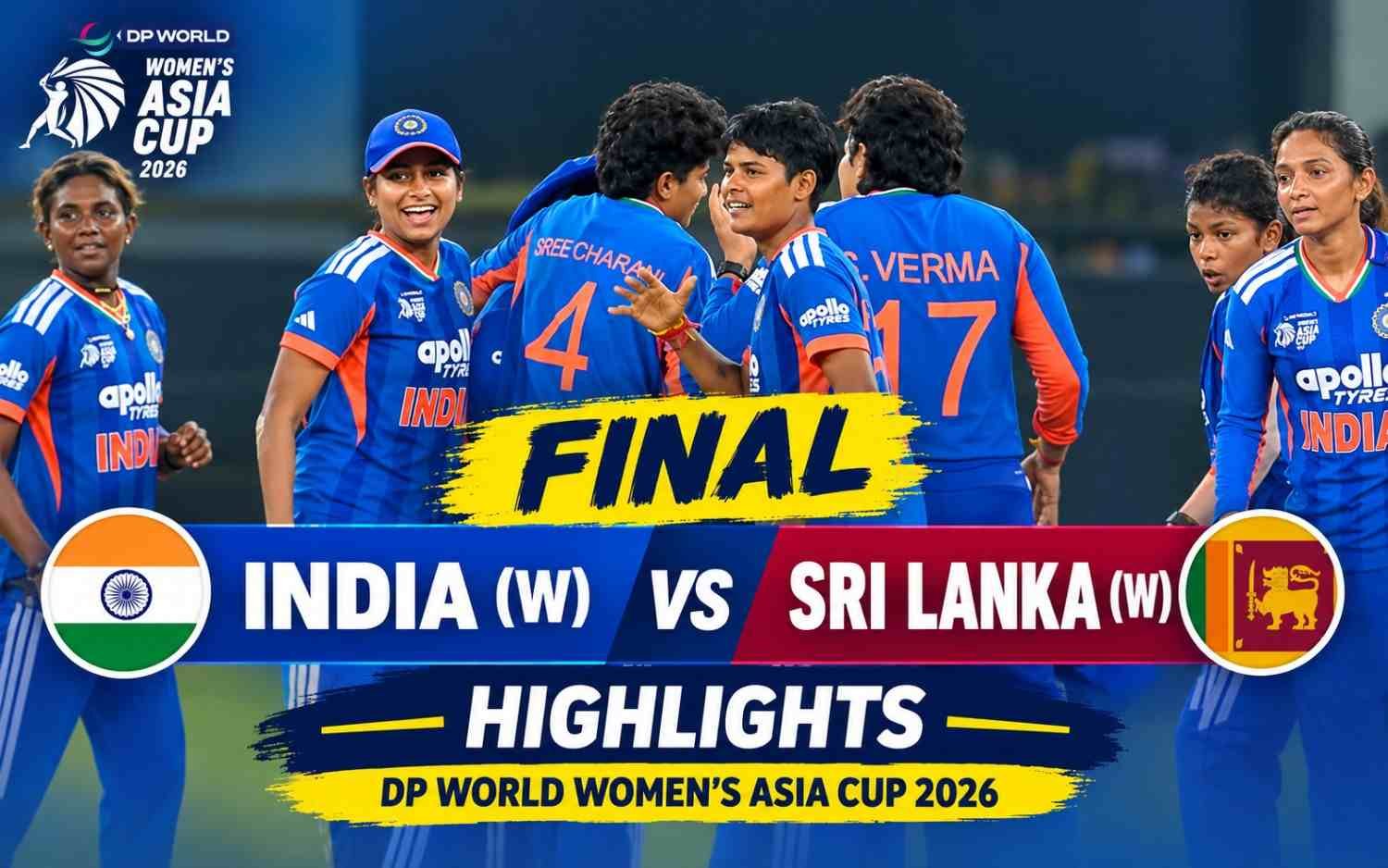
Cricket Highlights | Final | India (W) v Sri Lanka (W) | DP World Women’s Asia Cup 2026
Match Summary
| Match Detail | Information |
|---|---|
| Tournament | DP World Women’s Asia Cup 2026 |
| Match | Final |
| Teams | India Women vs Sri Lanka Women |
| Date | September 13, 2026 |
| Venue | Dubai International Cricket Stadium, Dubai |
| India Women | 183/5 in 20 overs |
| Sri Lanka Women | 111 all out in 20 overs |
| Result | India Women won by 72 runs |
| Top India Batter | Shafali Verma – 68 off 39 balls |
| Other Major India Batter | Smriti Mandhana – 59 off 39 balls |
| Top Sri Lanka Batter | Chamari Athapaththu – 36 off 32 balls |
| Best India Bowler | Shree Charani – 4/20 |
| Other Key Bowler | Deepti Sharma – 3/19 |
| India Captain | Harmanpreet Kaur |
| Sri Lanka Captain | Chamari Athapaththu |
India Women produced a commanding performance in the DP World Women’s Asia Cup 2026 final, defeating Sri Lanka Women by 72 runs at the Dubai International Cricket Stadium. India posted 183/5 and then bowled Sri Lanka out for 111, completing a comprehensive victory and claiming a record eighth Women’s Asia Cup title.
Cricket Highlights | Final | India (W) v Sri Lanka (W) | DP World Women’s Asia Cup 2026
Match Overview & Key Highlights
The 2026 Women’s Asia Cup final brought together two sides that had earned their places in the championship match through impressive semifinal performances. India had defeated Bangladesh by 40 runs in the first semifinal, while Sri Lanka overcame Pakistan by four wickets in the second semifinal to set up a repeat of the previous edition’s final.
We entered the final with the contest expected to be closely fought, particularly because Sri Lanka possessed experienced match-winners such as Chamari Athapaththu, Harshitha Samarawickrama and Nilakshika Silva. India, meanwhile, had enormous batting depth through Smriti Mandhana, Shafali Verma, Harmanpreet Kaur, Jemimah Rodrigues and Richa Ghosh, supported by the all-round ability of Deepti Sharma.
The final, however, quickly developed into a one-sided contest. India’s opening pair of Shafali Verma and Smriti Mandhana provided the perfect platform, combining power with controlled strokeplay. Their partnership put Sri Lanka’s bowling attack under immediate pressure and established the foundation for a formidable total.
India eventually finished on 183/5, a total that demanded an exceptional chase from Sri Lanka. The response never reached the required momentum. Sri Lanka lost wickets at crucial intervals, and India’s spin attack steadily tightened the pressure. Shree Charani’s four-wicket haul and Deepti Sharma’s three wickets proved decisive as Sri Lanka were dismissed for 111.
First Innings Analysis: India Build a Match-Winning Total
India’s batting innings was defined by an outstanding opening partnership. Shafali Verma scored 68 from 39 deliveries, while Smriti Mandhana contributed 59 from 39 balls. Their combined effort gave India exactly the kind of explosive beginning required in a T20 final.
Shafali was particularly destructive. She reached her half-century from only 24 balls, registering the fastest fifty of the Women’s Asia Cup according to match reports. Her innings contained seven boundaries and demonstrated why her aggressive approach can change the complexion of a game within a few overs.
Mandhana provided the ideal counterbalance. Rather than attempting to replicate Shafali’s approach on every delivery, she combined timing, placement and selective attacking strokes. The result was a high-value partnership that forced Sri Lanka to search for breakthroughs while India continued accumulating runs.
The early scoring rate was crucial because it gave India’s middle order freedom. Once Shafali and Mandhana had established the platform, Sri Lanka needed wickets rather than simply restricting boundaries. That pressure created opportunities for India’s batters later in the innings.
India eventually reached 183/5 in 20 overs, a total that gave Harmanpreet Kaur’s side significant control heading into the second innings.
From a tactical perspective, India’s first innings demonstrated the value of maximizing the powerplay without sacrificing wickets. The opening pair established a strong scoring base, allowing India to maintain pressure even after wickets fell later.
Turning Point & Crucial Performances
The defining feature of the final was the contrast between India’s batting execution and Sri Lanka’s inability to maintain momentum during the chase.
Shafali Verma was the central figure in India’s batting performance. Her 68 off 39 balls transformed the opening phase of the innings. By attacking early and forcing Sri Lanka’s bowlers away from their preferred lengths, she created scoring opportunities across the ground.
Smriti Mandhana’s 59 off 39 balls was equally important. The left-hander’s contribution ensured that Sri Lanka could not focus exclusively on Shafali. Together, the openers provided India with a commanding platform.
Sri Lanka’s response initially had hope through Chamari Athapaththu, who scored 36 from 32 balls. As captain and one of Sri Lanka’s most experienced players, Athapaththu represented the visitors’ principal route back into the contest. Her dismissal, however, exposed the middle order to India’s increasingly effective spin attack.
Shree Charani emerged as one of the biggest match-winners of the final. Her outstanding figures of 4/20 destroyed Sri Lanka’s batting resistance. She repeatedly found ways to attack the stumps and force batters into difficult scoring options. Her spell became particularly valuable once India’s fielding pressure combined with disciplined bowling.
Deepti Sharma provided another major blow with an exceptional 3/19 from four overs. Her ability to vary pace and trajectory made run-scoring increasingly difficult for Sri Lanka’s middle and lower order. The combination of Charani and Deepti effectively removed the possibility of a late Sri Lankan recovery.
Nilakshika Silva, who made 22 from 16 deliveries, attempted to provide some resistance, but Sri Lanka required a much larger partnership to keep the chase alive. Once wickets continued to fall, the required run rate became practically impossible to manage.
The decisive tactical lesson was India’s ability to attack Sri Lanka through spin once the chase entered its middle phase. Rather than allowing Sri Lanka to rebuild comfortably, India kept taking wickets and maintained scoreboard pressure.
Second Innings & Tactical Breakdown
Sri Lanka required 184 runs to win, meaning a strong start was essential. However, India’s bowlers prevented the chase from developing into a sustained assault.
The Sri Lankan innings ended at 111 all out in 20 overs, leaving India with a winning margin of 72 runs.
The difference between the two innings was not simply the final score. It was India’s superior ability to convert promising phases into decisive periods of dominance.
India’s bowlers consistently attacked the stumps and used spin effectively. Deepti Sharma’s 4-0-19-3 and Shree Charani’s four-wicket haul meant Sri Lanka could not preserve wickets for a final-overs assault.
The Indian fielding unit also contributed to the pressure. Sri Lanka needed boundaries at regular intervals, but India’s disciplined bowling ensured that many deliveries were difficult to attack cleanly.
From Sri Lanka’s perspective, the biggest problem was the absence of a substantial middle-order partnership after Athapaththu’s dismissal. The chase required controlled aggression, but successive wickets prevented Sri Lanka from establishing the platform needed for a late surge.
India’s tactical plan therefore worked on two levels: the batters created a substantial target, and the bowlers prevented Sri Lanka from getting anywhere close to it.
Key Statistics & Milestone Records
- India Women: 183/5 in 20 overs
- Sri Lanka Women: 111 all out in 20 overs
- India won by 72 runs.
- Shafali Verma: 68 off 39 balls, including a rapid half-century.
- Smriti Mandhana: 59 off 39 balls, providing crucial support at the top.
- Chamari Athapaththu: 36 off 32 balls, Sri Lanka’s leading scorer.
- Nilakshika Silva: 22 off 16 balls, one of Sri Lanka’s better contributions during the chase.
- Shree Charani: 4/20, the outstanding bowling performance.
- Deepti Sharma: 3/19, adding major middle-order breakthroughs.
- India’s victory delivered a record-extending eighth Women’s Asia Cup title.
- India entered the final after defeating Bangladesh Women by 40 runs in the semifinal, while Sri Lanka had beaten Pakistan Women by four wickets.
These numbers underline how comprehensively India controlled the final. Their top-order batting produced the decisive advantage, while their spin-heavy bowling attack ensured that Sri Lanka never established a sustained chase.
Post-Match Impact & What’s Next
India’s victory represents another major milestone in the history of the Women’s Asia Cup, as Harmanpreet Kaur’s team secured the country’s eighth title. The result also provided a measure of redemption after Sri Lanka had beaten India in the previous edition’s final.
For Sri Lanka, reaching the final remains a significant achievement. Their semifinal victory over Pakistan demonstrated the depth and competitiveness of the squad, while players such as Chamari Athapaththu, Harshitha Samarawickrama and Nilakshika Silva remain central to their future ambitions.
For India, the final offered an ideal demonstration of balanced T20 cricket: explosive opening batting, strong middle-order depth, intelligent spin bowling and sustained scoreboard pressure. Shafali Verma, Smriti Mandhana, Shree Charani and Deepti Sharma were the principal performers in a final that firmly belonged to India.
The DP World Women’s Asia Cup 2026 final will therefore be remembered not only for India’s 72-run victory, but also for the way the champions combined aggressive batting with disciplined bowling to complete another landmark continental triumph.