
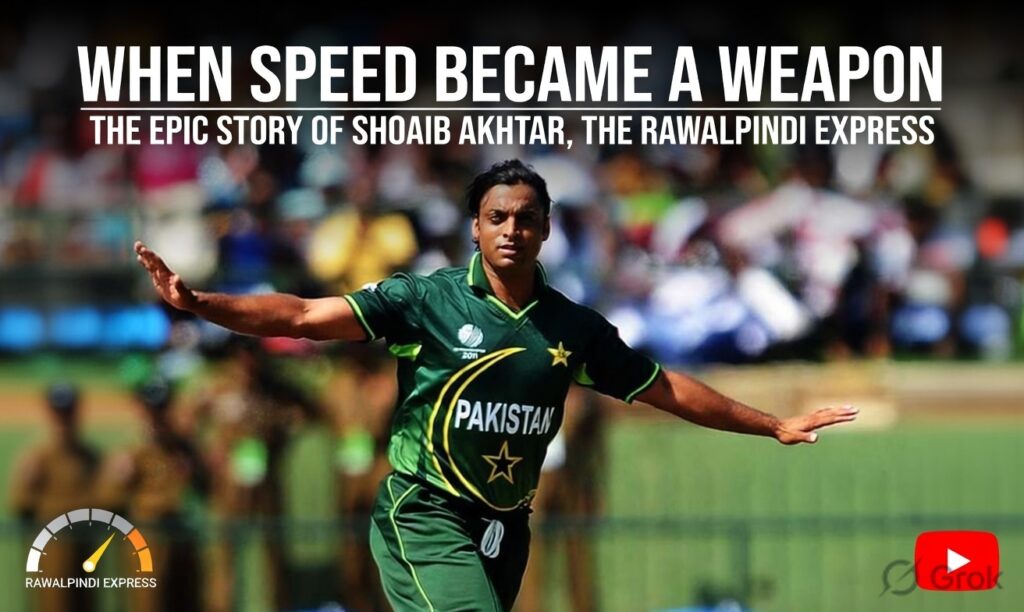
In the roaring cauldron of Eden Gardens on February 17, 1999, a young Pakistani fast bowler stepped up to deliver two thunderous in-swinging yorkers that silenced over 100,000 chanting Indian fans. Rahul Dravid’s stumps were shattered. Then Sachin Tendulkar, the “God of Cricket,” walked in — only to be sent packing moments later. The crowd fell silent. Shoaib Akhtar had arrived.
This was the moment speed became a weapon — and cricket gained its most feared, controversial, and electrifying fast bowler.
A Frail Child Who Defied Death
Shoaib Akhtar’s early life read like a medical nightmare. As a child, he suffered from knee problems, flat feet, and whooping cough. He was so weak that doctors doubted he would survive. Walking was a struggle until age five.
Yet in early 1994, during open trials in Lahore led by Pakistan legend Zaheer Abbas, one bowler stood out. Abbas took one look and declared, “I want this guy.” Akhtar joined the Pakistan International Airlines (PIA) domestic setup — but sat on the bench for two full years without a single match. Frustrated, he tore up his contract and returned home to Rawalpindi.
In 1996, everything changed. Joining the Agricultural Development Bank team, he took 75 wickets in his debut season. Selectors, including PCB CEO Majid Khan, noticed. Pakistan A tours followed, and the raw pace was impossible to ignore.
The International Debut and First Taste of Glory
Akhtar’s Test debut came in 1997 against West Indies. He took just two wickets, but coach Haroon Rashid was stunned by the speed. With legends Wasim Akram and Waqar Younis ahead of him, opportunities were scarce — until fixing allegations rocked the team.
In South Africa, Akhtar replaced Akram and delivered a match-winning 5/43 in Durban — Pakistan’s first-ever Test win on South African soil. His ODI debut in Zimbabwe ended in disaster after just five overs: a hyper-extended knee injury sidelined him for seven months.
Kolkata 1999: The Birth of the Rawalpindi Express
The 1999 Asian Test Championship against India became the turning point. After a heated fallout between Akram and Younis, Akhtar was thrown into the fire in Kolkata.
India were cruising at 147/3. Akhtar returned to the attack and needed just two balls to change history:
- Rahul Dravid clean bowled.
- Sachin Tendulkar yorked.
India collapsed to 107 all out. Akhtar finished with 4/71 and 4/47 — eight wickets in the match. Pakistan reached the 1999 World Cup final (losing to Australia), but Akhtar took 16 wickets in 10 games and earned the iconic nickname “Rawalpindi Express.”
The Medical Marvel: Breaking His Own Body
Experts later revealed the secret behind both his genius and fragility. A University of Western Australia study showed Akhtar’s joints hyperextended up to 42 degrees (normal is 20). Combined with flat feet and an explosive action, every delivery was destroying his body.
Yet he played 15 years at the highest level — a medical marvel who refused to slow down.
161 km/h: The Fastest Ball Ever Bowled
By 2002, Akhtar was consistently clocking over 155 km/h. In 2003, during the World Cup against England, he unleashed a delivery officially recorded at 161.3 km/h (100.2 mph) — the fastest ball in cricket history (though some debate the deflection by Nick Knight). The world stood in awe.
The Downfall: Talent vs Discipline
Success brought controversy. Akhtar was reported for chucking in 1999 (later cleared), battled repeated injuries, and clashed with authority. A “gangster” look, on-field abuse (including a two-match ban for insulting South African Paul Adams), and dressing-room issues with Inzamam-ul-Haq and coach Bob Woolmer followed.
In 2006, a doping positive led to a two-year ban (served one). He failed a fitness test before the 2007 World Cup and missed both ODI and T20 events. Media comments about PCB contracts earned fines and a “lifetime ban” warning.
His final international appearance came in the 2011 World Cup against New Zealand — the curtain call for one of cricket’s most explosive careers.
Final Words: An Unbreakable Legacy
Nearly 18 years after retirement, Shoaib Akhtar’s record still stands untouched. As the video powerfully concludes:
“This record… Shoaib Akhtar had broken his body [for it]. After which, he got the title of the world’s fastest bowler… no other fast bowler can reach that level — a bowler whom the batsman used to think twice before facing.”
Batsmen preferred standing at the non-striker’s end when he ran in. That fear factor, that raw aggression, that legendary pace — it remains unmatched.
Shoaib Akhtar didn’t just bowl fast — he turned speed into a psychological weapon. From a fragile child to the undisputed king of pace, his story is a reminder that talent alone isn’t enough; unbreakable will and raw aggression can rewrite history.
Watch the full documentary on YouTube: When Speed Became A Weapon: The Story of Shoaib Akhtar by Popcorn Speaks.
What’s your favourite Shoaib Akhtar moment? The Eden Gardens yorkers or the 161 km/h rocket? Drop your thoughts in the comments!
Video Source: YouTube