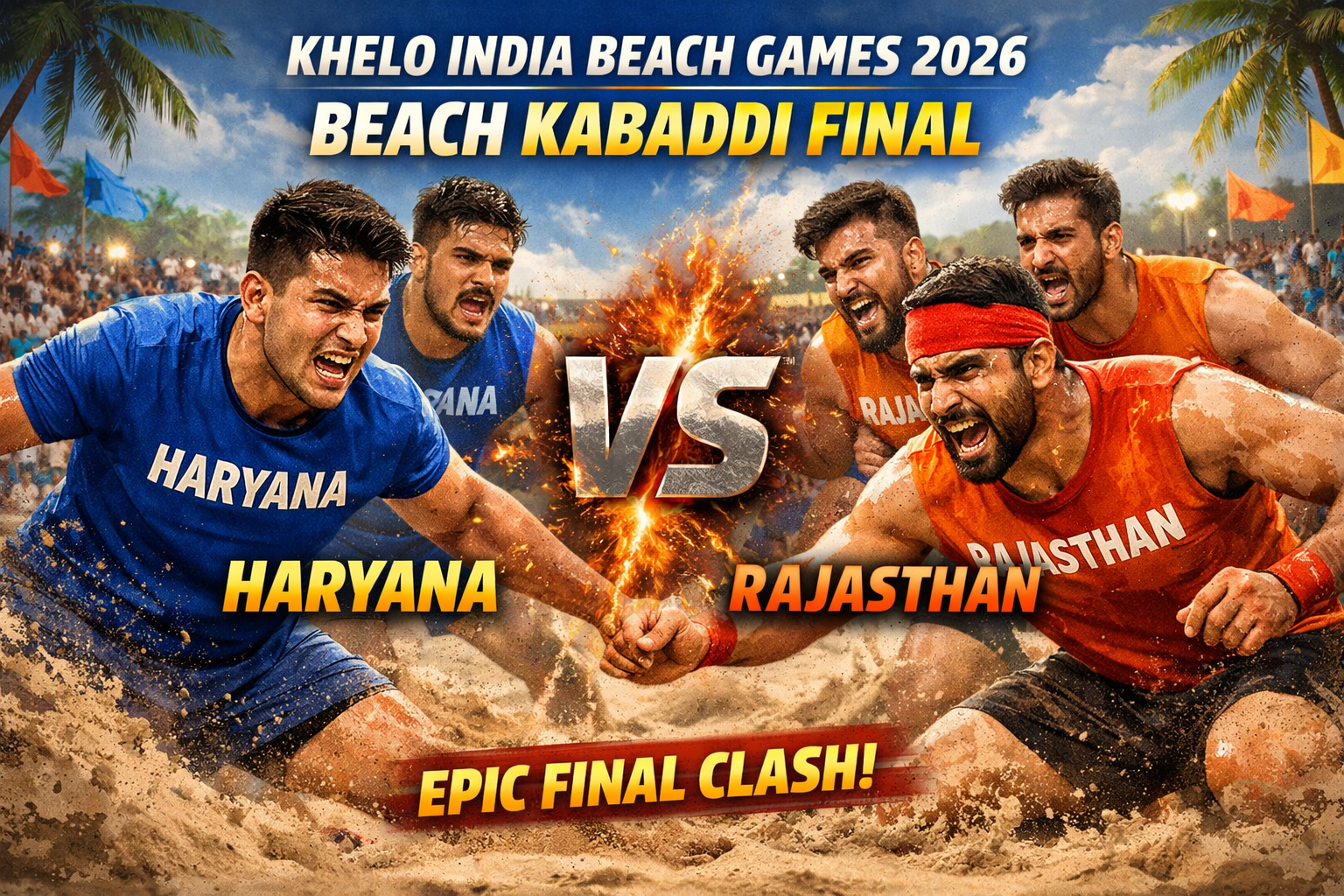
The sun-kissed shores of Ghoghla Beach in Diu came alive on Day Four of the Khelo India Beach Games 2026, as the men’s Beach Kabaddi semi-finals delivered edge-of-the-seat action. This second edition of the games, running from January 5 to 10, features over 1,300 athletes from 25 states and 6 Union Territories competing in six medal disciplines, including Beach Kabaddi. Hosted by Dadra & Nagar Haveli and Daman & Diu, the event showcases unique beach variants of traditional sports, emphasizing stamina, power, and adaptability on a sandy surface. With motivational chants echoing themes of national pride and resilience, the semi-finals highlighted why Beach Kabaddi is captivating audiences nationwide.
Haryana Edges Out Maharashtra in a Nail-Biter
The first semi-final pitted Haryana (in red jerseys) against Maharashtra (in yellow), in a match that epitomized the intensity of Beach Kabaddi. Played on an 11m x 7m court with 30 cm of sand—no mats for cushioning—every raid and tackle demanded extra effort. Rules differ from traditional Kabaddi: no empty raids allowed, points via touches or tackles, four players per side on the court (from six total, plus two subs), and two 15-minute halves with a five-minute break.
Haryana, undefeated in the tournament, won the toss and started strong. Captain Harsh led as both raider and defender, while Yogesh excelled in thigh holds and double leg holds. Dixit and Vivek Sharma contributed crucial raids and catches. Maharashtra’s captain Sahil Subhash Rane spearheaded raids, backed by defenders like Dadas Shivaji Pujari (ankle holds) and raiders Abhishek Tukaram Gange and Sanket Suresh Sawant.
The game was a rollercoaster: Haryana jumped to a 6-3 lead, but Maharashtra tied at 6-6 with Sahil’s multi-point raid. By halftime, Haryana led 11-9. The second half saw Maharashtra briefly take a 24-23 lead, but Haryana’s “orchestrated” defense—coordinated ankle and leg holds—turned the tide. Despite Sahil’s injury (treated with pain relief spray), he battled on. Green cards were issued for minor fouls, and timeouts allowed strategic resets. Haryana clinched a thrilling 33-31 victory, advancing to the final after earlier wins over Andhra Pradesh (53-16), Dadra & Nagar Haveli/Daman (55-9), and Uttar Pradesh (43-31).
Key highlights included Yogesh’s defensive masterclass and Harsh’s all-around performance, underscoring the physical demands of sand-based play.
Rajasthan Dominates Uttar Pradesh in a One-Sided Affair
The second semi-final featured Rajasthan (yellow) versus Uttar Pradesh (sky blue), with Rajasthan emerging as clear favorites after topping their pool. Rajasthan’s squad boasted stars like captain Sachin Tanwar, Vijendra Singh Chaudhary, Chetan Kumar Chaudhary, Jitendra Yadav, Rahul Chaudhary, and Jai Bhagwan. Uttar Pradesh, runners-up in their group, fielded captain Anshul, Nikhil Kumar, Abhishek Singh, Kultar, Avinash Yadav, and Suraj Kumar.
Rajasthan asserted dominance early, leading 17-7 at halftime in the initial coverage, extending to 27-16 by the end of the first half in detailed play-by-play. Jai Bhagwan’s raids were unstoppable, often yielding multiple points through ankle holds and touches, while Jitendra Yadav anchored the defense. Sachin Tanwar and Rahul Chaudhary added flair with coordinated attacks.
Uttar Pradesh fought valiantly—Abhishek Singh and Suraj Kumar scored sporadically—but fatigue set in against Rajasthan’s “well-oiled machine.” Kultar’s raids faltered, and despite coach Harphool Singh’s efforts, they couldn’t bridge the gap. Rajasthan surged to a commanding victory, reaching 57 points while Uttar Pradesh managed around 37 total (21 in the second half alone for UP, but overwhelmed overall). This win propelled Rajasthan to the final against Haryana, while Uttar Pradesh secured a bronze medal as a losing semi-finalist.
Standout moments: Jai Bhagwan’s multi-point raids and Rajasthan’s unbreakable defense, highlighting their strategic prowess.
Key Players and Expert Insights
Throughout the semis, players like Haryana’s Yogesh (Junior World Cup gold medalist) and Maharashtra’s Sahil demonstrated resilience amid injuries and high-stakes pressure. Experts like Ram Mehar Singh praised Khelo India for fostering talent, providing facilities, jobs, and national camp opportunities for athletes such as Sachin Tanwar, Jitendra Yadav, Jai Bhagwan, and Yogesh.
Beach Kabaddi’s adaptations—requiring more stamina due to sand—were emphasized, with demonstrations of techniques like thigh holds, ankle holds, double leg holds, and touch outs adding educational value to the broadcast.
The Bigger Picture: Khelo India’s Impact
Launched to promote grassroots sports, Khelo India Beach Games blend competition with scenic beauty, inclusivity (31 states/UTs participating), and non-medal demos like Mallakhamb and Tug of War. Medal sports include Beach Soccer, Volleyball, Sepak Takraw, Kabaddi, Pencak Silat, and Open Water Swimming. The event’s live streaming on DD Sports and YouTube amplifies its reach, inspiring young athletes and fostering national unity.
As Haryana and Rajasthan gear up for the final, expect more fireworks on the sand. Stay tuned for updates from this vibrant celebration of Indian sports!